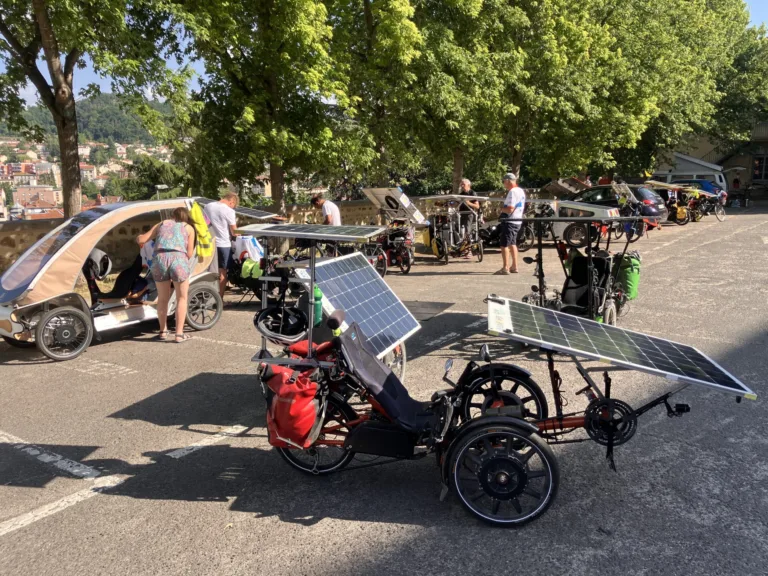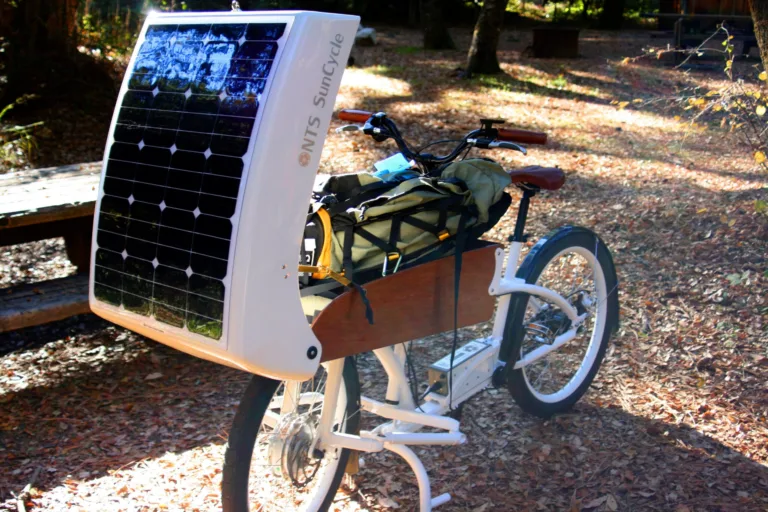
Most small panels that fit on a bike deliver around 18–20 V. A 36 V e-bike battery needs up to 42 V to charge, a 48 V battery up to 54.6 V. A normal MPPT controller can only lower voltage – so it can’t help. The answer is a boost MPPT controller, which tracks the panel’s best working point and steps the voltage up.
Why not just wire panels in series?
You could wire panels in series until their voltage beats the battery’s. On a bike that rarely works: you would need more panels than you have room for, and in series one shaded panel slows the whole string – see partial shading. With a boost controller, panels can run in parallel and each one keeps working on its own.
The rules that matter
- Input below output: the panel’s voltage must always stay below the battery’s – otherwise the boost converter cannot regulate.
- Exact output voltage: it must match your battery’s charge voltage precisely – see the lithium-ion and LiFePO4 guides.
- Real MPPT: cheap boost modules without tracking waste a large part of the panel’s power.
- Through the BMS: charge via the charge port and its BMS, fused close to the battery.
Is boost right for you?
If your panel area is limited and your battery is 36 V or 48 V, boost is usually the cleanest solution. For large arrays on trailers or campers, a buck MPPT controller with panels in series can be cheaper. Many solar e-bikes in our community run exactly this setup.