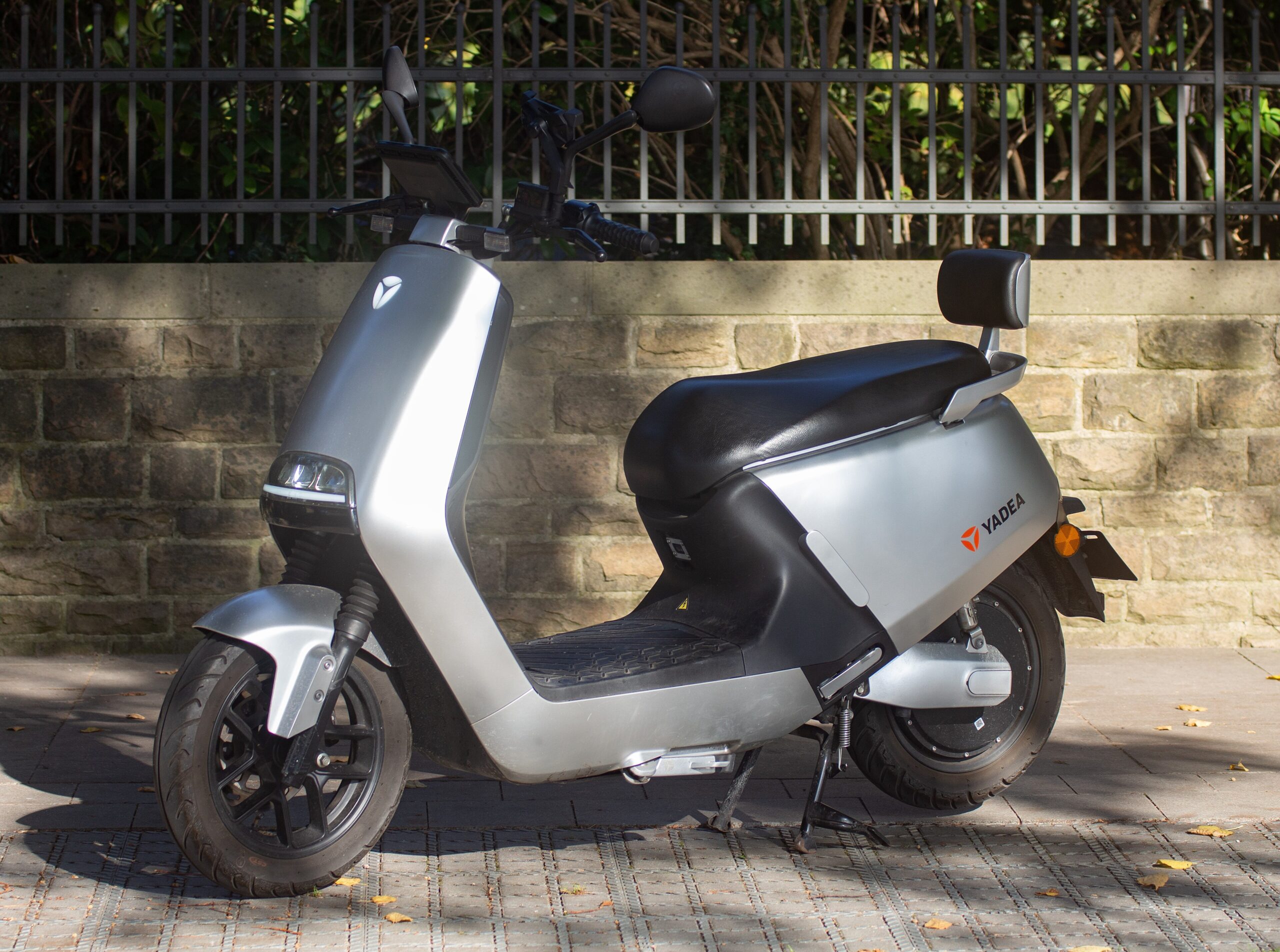
For years, “battery” in the e-bike and scooter world has meant one thing: lithium-ion. That is starting to change. Yadea, the world’s largest maker of electric two-wheelers, now sells scooters powered by sodium-ion batteries, a chemistry that needs no lithium, no cobalt and no nickel.
What Yadea launched
At its sodium vehicle conference in Hangzhou, Yadea opened presales for four models with sodium-ion packs, priced from 3,299 to 4,299 yuan (roughly $450 to $590):
- Yadea Q1 sodium-ion – 3,299 yuan
- DE3 sodium-ion – 3,499 yuan
- G30 Lite sodium-ion – 3,699 yuan
- Guanneng Q50 sodium-ion – 4,299 yuan
The packs use cells with a hard-carbon anode. Yadea quotes an energy density of about 145 Wh/kg and up to 1,500 cycles at room temperature, and says one model charges to 80% in around 15 minutes. At EICMA in Milan in November 2025, the company followed up with a higher-performance pack and a solar charging station with built-in sodium storage.
Why sodium matters
Sodium is one of the most abundant elements on Earth, and sodium-ion cells can be built on similar production lines to lithium cells. Their main trade-off is weight: 145 Wh/kg is below today’s best lithium cells. For a city scooter that is a fair deal, especially because sodium cells keep much more of their power in freezing weather, an area where lithium iron phosphate (LFP) packs struggle.
What it means for solar mobility
For solar riders the interesting part is not the scooter, it is the storage. A cheap, robust, cold-tolerant battery is exactly what you want in a solar charging station, a camper or a trailer that sits outside all winter. If sodium cells reach Europe and North America in volume, expect to see them first in stationary buffers and budget commuter vehicles, while long-range touring e-bikes stay with lithium for a while longer.
Have you seen sodium-ion cells for DIY builds yet? Tell us in the community and share your project with us.
Sources: CarNewsChina · electrive · Electrek (EICMA 2025)
Photo (Yadea G5 in Hamburg): Wikisympathisant / Wikimedia Commons, CC BY-SA 4.0