
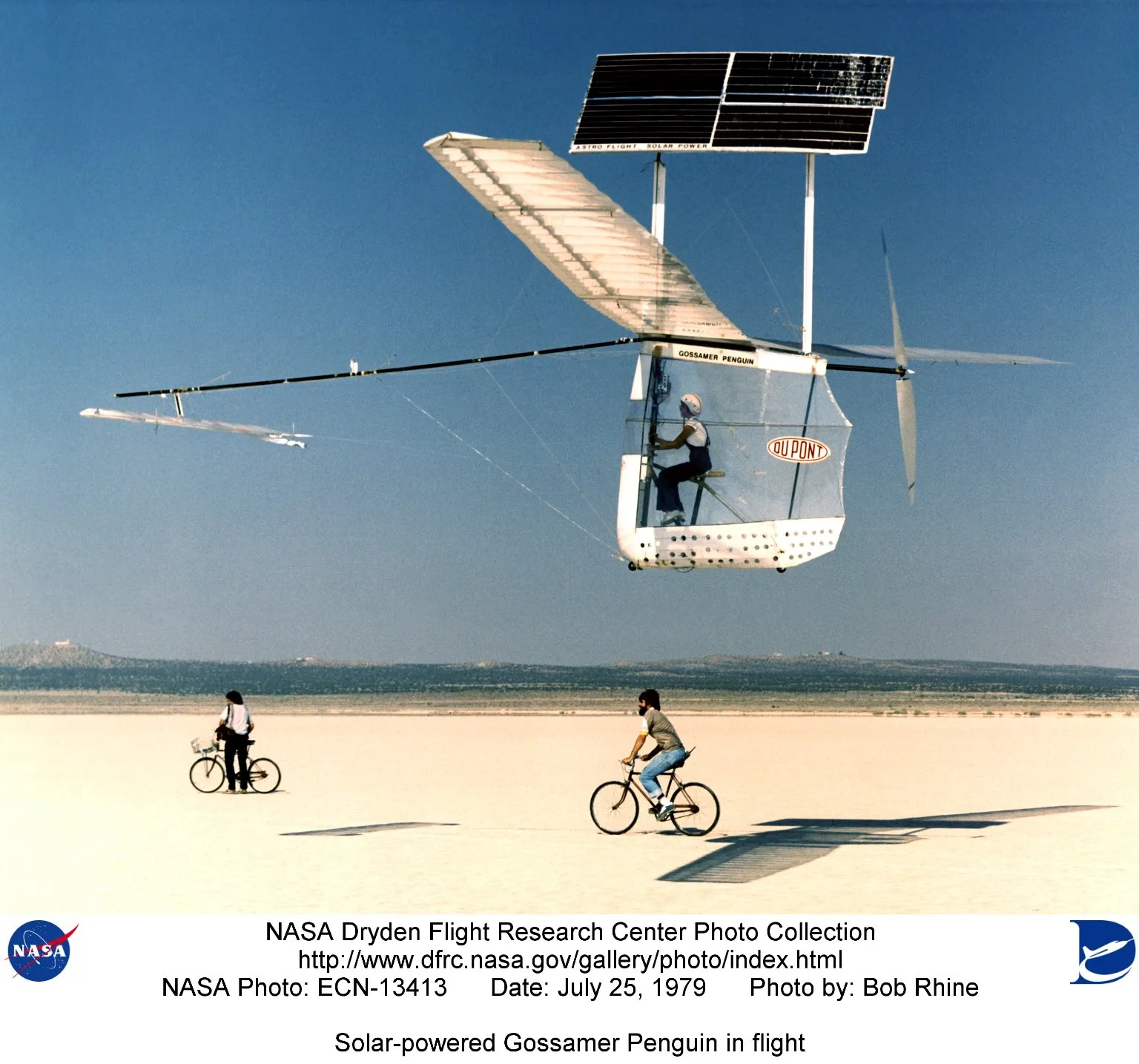
Before Solar Impulse, before Helios, there was a fragile-looking craft of tubes, foil and solar cells. Gossamer Penguin was built by Paul MacCready and his company AeroVironment, the team that had just won fame with the human-powered Gossamer Albatross crossing of the English Channel.
The idea was simple and bold: replace the pedalling pilot with sunlight. A 541 W solar panel made of 3,920 cells was mounted above the 22 m wing and drove an Astro-40 electric motor through a 133:1 reduction gear. Empty, the aircraft weighed only 31 kg (68 lb). Early test flights in 1979 were made on batteries, with MacCready’s 13-year-old son Marshall (36 kg) as pilot.
The official solar-powered demonstration came on 7 August 1980 at NASA’s Dryden Flight Research Center, when pilot Janice Brown flew 3.14 km (1.95 mi) on sunlight alone. It was slow, low and fragile, but it proved that a person could fly on solar power.
The lessons went straight into its sturdier successor, Solar Challenger. In 1981 it flew across the English Channel on solar power, and four decades of solar aviation followed.
Technical data
| Builder | Paul MacCready, AeroVironment (USA) |
|---|---|
| Solar | 541 W panel, 3,920 solar cells |
| Motor | AstroFlight Astro-40 electric motor, 133:1 reduction |
| Wingspan | 22 m (71 ft) |
| Empty weight | 31 kg (68 lb) |
| First flight | 18 May 1979 (battery power) |
| Solar flight | 7 August 1980, pilot Janice Brown, 3.14 km |
| Successor | Solar Challenger (English Channel crossing, 1981) |
Photo: NASA on The Commons / Wikimedia Commons, No restrictions