
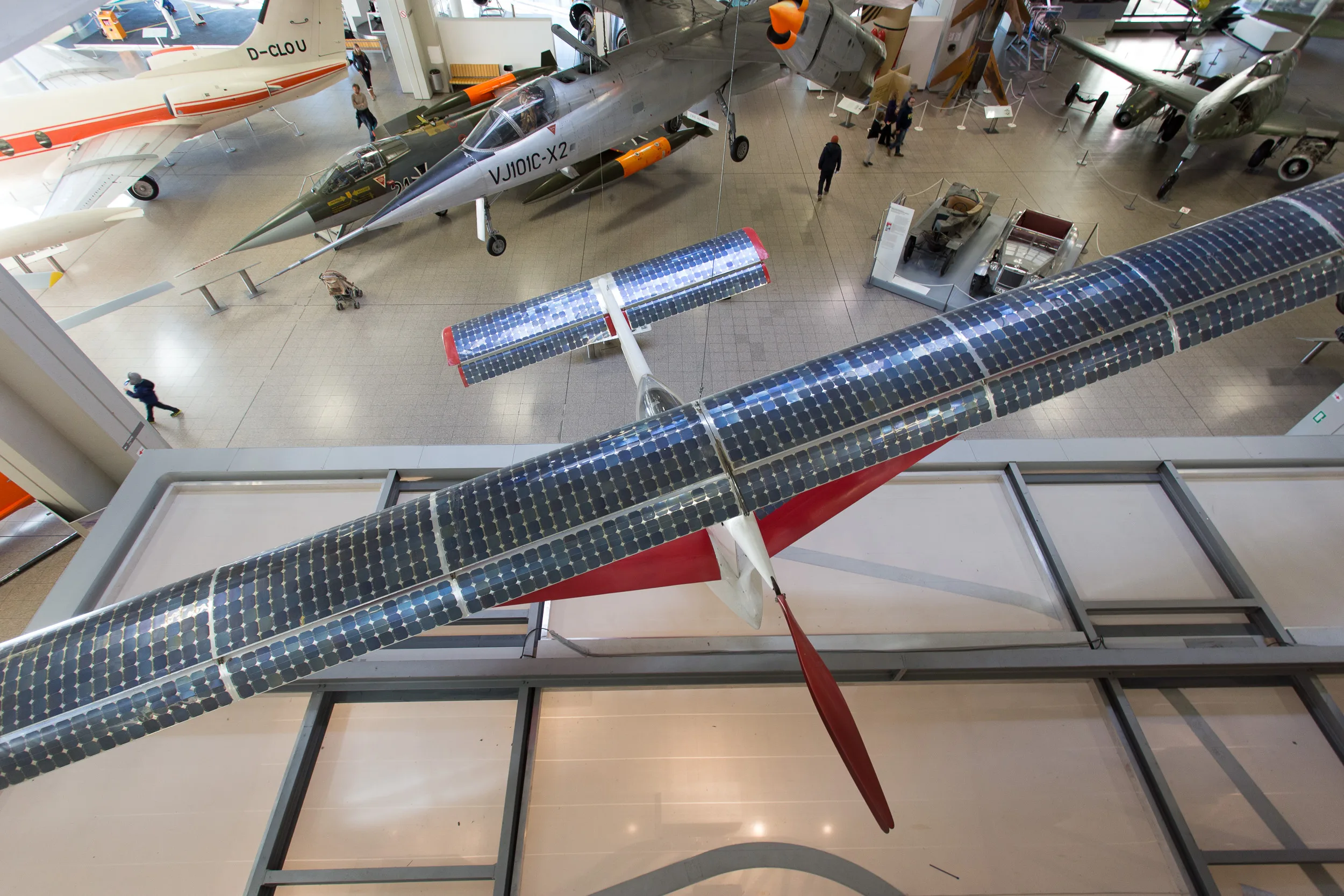
In the early 1980s, when solar cells were still rare and expensive, German designer Günther Rochelt decided to build an aircraft that could fly for hours on sunlight. Starting in 1980 from a canard design by Swiss designer Hans Farner, he created Solair I.
Its 16 m wing was covered with about 2,500 solar cells, embedded in silicone and protected by a polyester film, producing roughly 1.8–2.2 kW. With an empty weight of only about 120 kg and 22.3 m² of wing area, the aircraft could stay aloft on very little power.
On 21 August 1983, at Unterwössen in Bavaria, Solair I made a flight of 5 hours and 41 minutes, “mostly on solar energy and also thermals”. At the time this was a remarkable endurance flight for a solar aircraft.
Today Solair I hangs in the Deutsches Museum Flugwerft Schleissheim near Munich, where this photo was taken. It reminds visitors that solar flight was already real decades before Solar Impulse.
Technical data
| Builder | Günther Rochelt (Germany), from 1980; canard design by Hans Farner |
|---|---|
| Type | Single-seat canard solar aircraft |
| Solar | ~2,500 cells in silicone under polyester film, ~1.8–2.2 kW |
| Wingspan | 16.0 m, wing area 22.3 m², length 5.4 m |
| Empty weight | ~120 kg |
| Key flight | 21 August 1983, Unterwössen: 5 h 41 min, mostly solar |
| Today | Deutsches Museum Flugwerft Schleissheim |
Photo (Deutsches Museum): Alex Froloff / Wikimedia Commons, CC BY-SA 4.0
Sources: Wikipedia: Solair · Deutsches Museum