
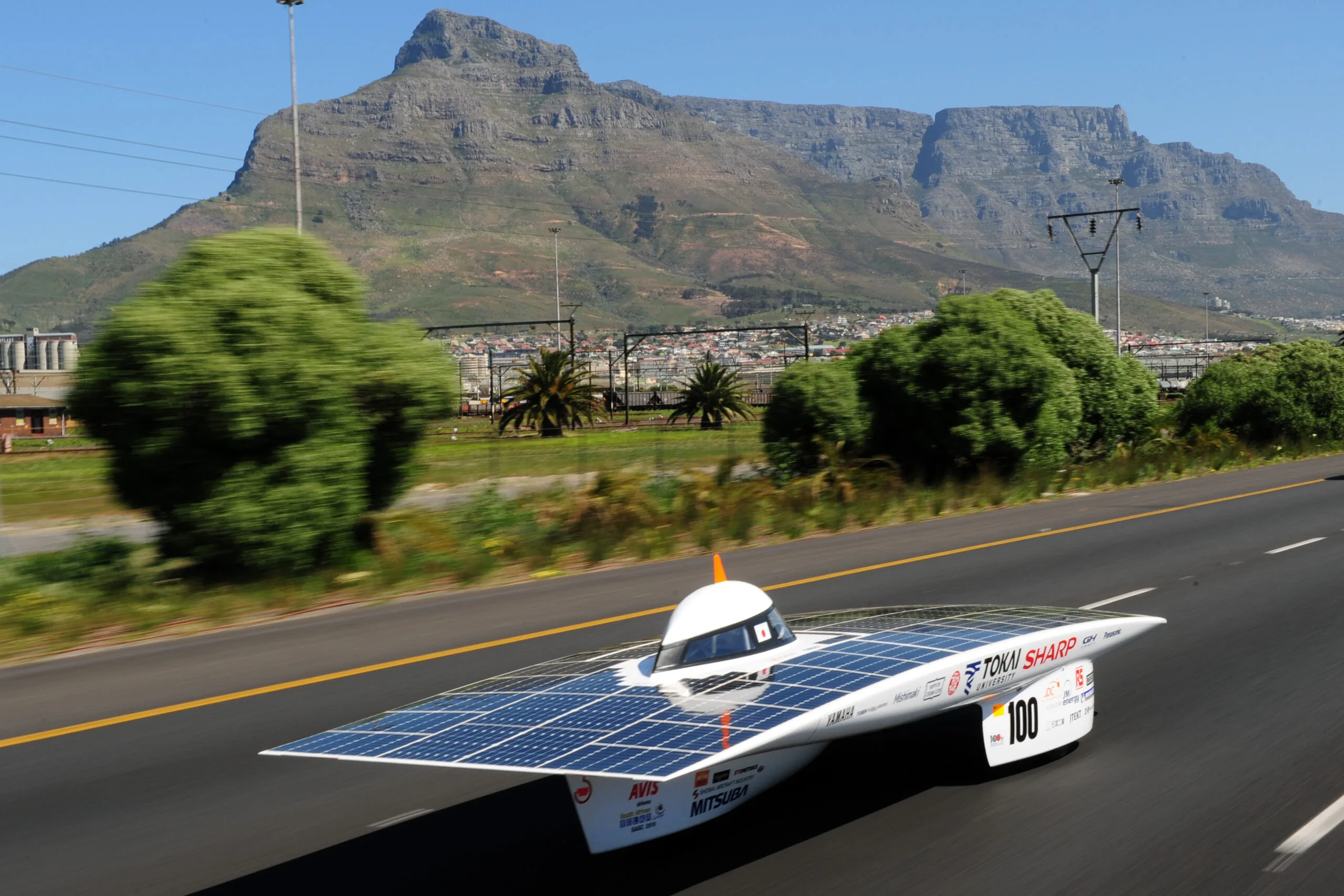
In 2009 a Japanese university team ended years of Dutch dominance at the World Solar Challenge, the 3,000 km race across Australia from Darwin to Adelaide. Their weapon was the Tokai Challenger, a flat, three-wheeled single-seater built by the Tokai University Solar Car Team.
The secret was in the cells. Sharp supplied 2,176 compound solar cells of the type used on space satellites, with around 30% efficiency and about 1.8 kW of output. Panasonic provided a 25 kg lithium-ion battery. With battery but without driver the car weighed just 160 kg, and its estimated top speed was about 160 km/h.
In the 2009 race it covered the 2,998 km in 29 hours 49 minutes, an average of 100.54 km/h on sunlight alone, and won. The team won again in 2011. In between, the car toured the 2010 South African Solar Challenge, where this photo was taken in front of Table Mountain.
Technical data
| Builder | Tokai University Solar Car Team (Japan) |
|---|---|
| Type | Single-seat, three-wheeled solar race car |
| Solar | 2,176 Sharp compound (space-grade) cells, ~30% efficiency, ~1.8 kW |
| Battery | Panasonic lithium-ion, 25 kg |
| Weight | 160 kg incl. battery, without driver |
| Top speed | ~160 km/h (estimated) |
| Record run | WSC 2009: 2,998 km in 29 h 49 min, Ø 100.54 km/h |
| Results | World Solar Challenge winner 2009 and 2011 |
Photo (South African Solar Challenge 2010): Hideki Kimura, Kohei Sagawa / Wikimedia Commons, CC BY-SA 3.0
Sources: Wikipedia: Tokai Challenger · IEEE Spectrum · Sharp: solar car history