
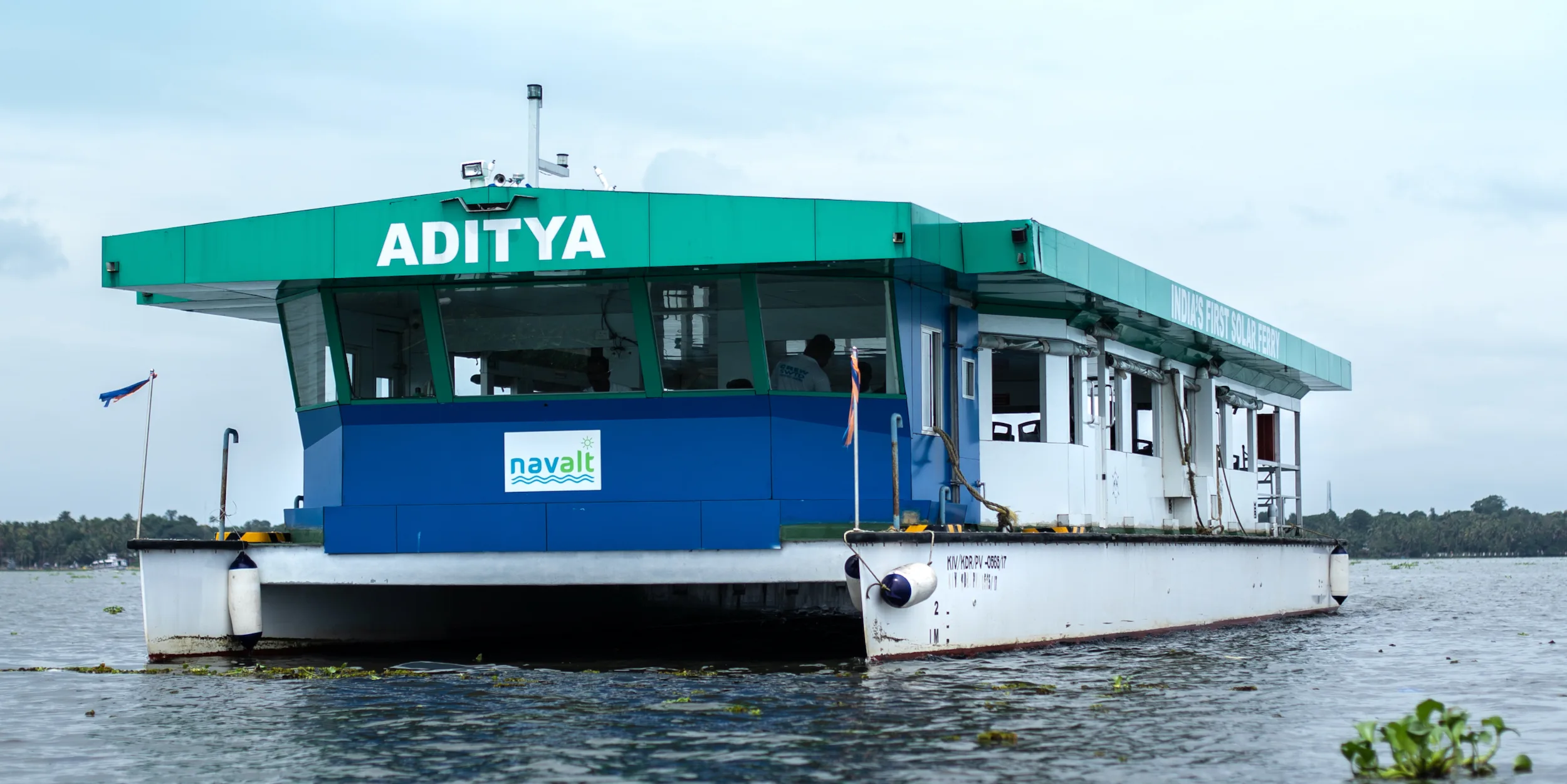
Every day since January 2017, a quiet blue-and-white catamaran has shuttled villagers, students and commuters across Vembanad Lake in Kerala. Aditya was India’s first solar-powered ferry, and it is one of the most convincing real-world arguments for solar boats anywhere.
It was designed and built by NavAlt Solar & Electric Boats, a start-up founded by young naval architect Sandith Thandasherry, with about ₹2 crore of funding from the Kerala government. The 21 × 7 m catamaran has a glass-reinforced plastic hull and an aluminium superstructure. A 140 m² solar roof (20 kW) charges a 50 kWh lithium battery, which drives two 20 kW electric motors to a top speed of about 7.5 knots.
Operated by the Kerala State Water Transport Department on the 2.5 km Vaikom – Thavanakkadavu route, Aditya makes about 22 trips a day with up to 75 passengers. Its daily running cost is around ₹180, compared with roughly ₹8,000 for a diesel ferry. By 2025 it had saved some 310,000 litres of diesel and over 740 tonnes of CO₂.
In 2020 Aditya won the Gustave Trouvé Award for the world’s best electric ferry, beating European finalists. It also earned the Solar Impulse Foundation’s Efficient Solution label.
Technical data
| Builder | NavAlt Solar & Electric Boats, Kochi (founder Sandith Thandasherry) |
|---|---|
| Operator | Kerala State Water Transport Department |
| Hull | Catamaran, GRP hull + aluminium superstructure, 21 × 7 m |
| Solar | 140 m², 20 kW |
| Battery | 50 kWh lithium-ion |
| Motors | 2 × 20 kW electric |
| Speed | Up to ~7.5 kn |
| Service | Since January 2017, ~22 trips/day, 75 passengers, Vaikom – Thavanakkadavu (2.5 km) |
| Award | Gustave Trouvé Award 2020, best electric ferry |
Photo: Samarjitbharat / Wikimedia Commons, CC BY-SA 4.0
Sources: Wikipedia: Aditya (boat) · Eco-Business · Onmanorama