
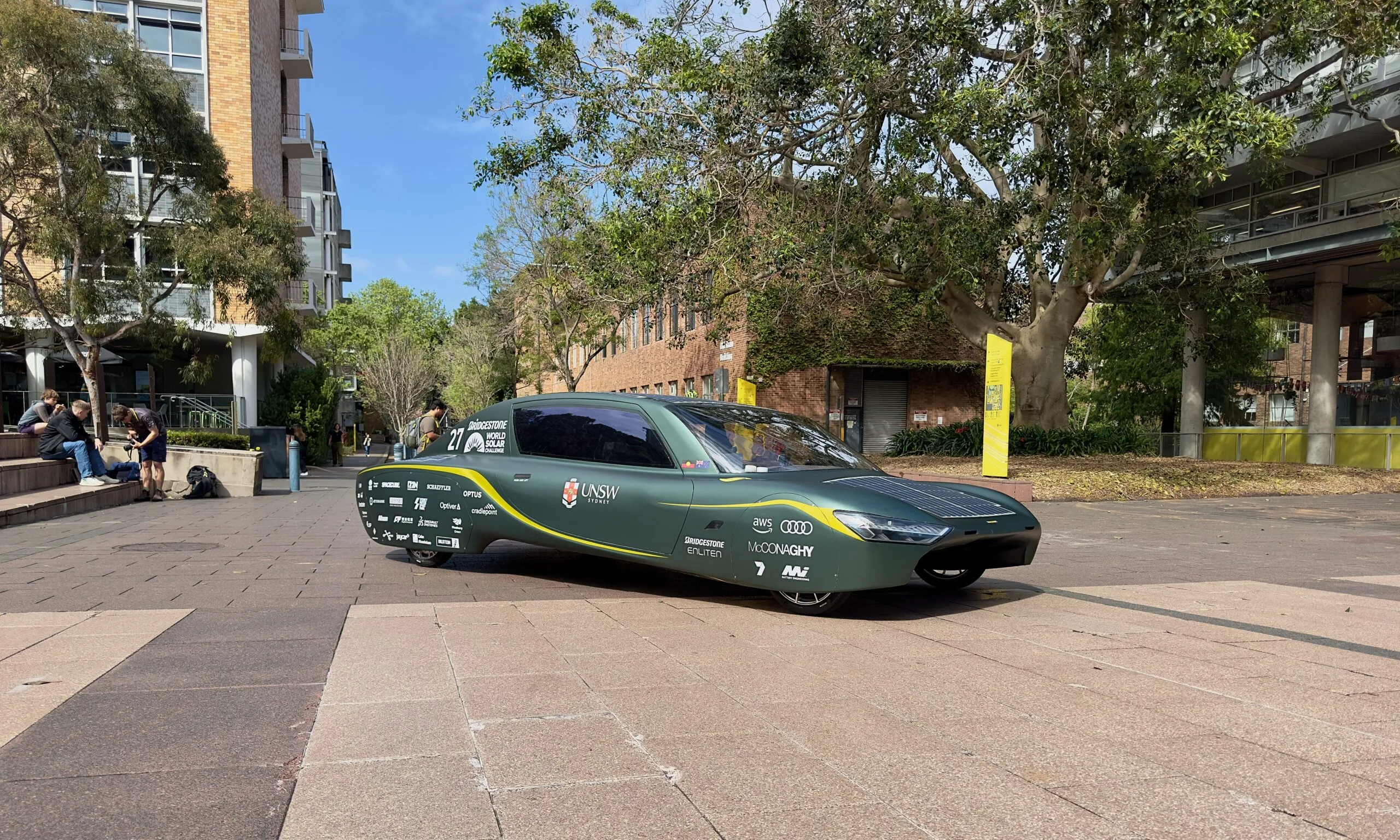
The students of UNSW Sunswift Racing in Sydney have been building solar cars since the 1990s. Their seventh car took everything they had learned and focused it on one idea: use as little energy as possible.
Sunswift 7 weighs only about 500 kg and has a remarkable drag coefficient of about 0.095, roughly a third of a typical modern car. It carries 4.6 m² of solar panels and a 38 kWh battery. Around 50 undergraduate students designed and built it over about 18 months.
In December 2022 the team took it to a test track and drove 1,000 km on a single charge in 11 hours, 52 minutes and 8 seconds, at an average of almost 85 km/h. That earned the Guinness World Record for the fastest electric vehicle over 1,000 km on one charge.
A year later, in October 2023, Sunswift 7 crossed Australia in the Bridgestone World Solar Challenge and won the Cruiser Class, which rewards practical, passenger-carrying solar cars, with a score of 91.1. Its predecessor Violet had already finished first across the line in Adelaide in 2019.
Technical data
| Builder | UNSW Sunswift Racing (University of New South Wales), ~50 students |
|---|---|
| Weight | ~500 kg |
| Drag | Cd ≈ 0.095 |
| Solar | 4.6 m² of panels |
| Battery | 38 kWh |
| Record | Guinness World Record: fastest EV over 1,000 km on one charge, 11 h 52 min 8 s (Dec 2022) |
| Race | Bridgestone World Solar Challenge 2023, Cruiser Class winner (score 91.1) |
Photo: Cars300 / Wikimedia Commons, CC BY-SA 4.0
Sources: UNSW: Sunswift 7 · CarExpert / Drive · Wikipedia: Sunswift