
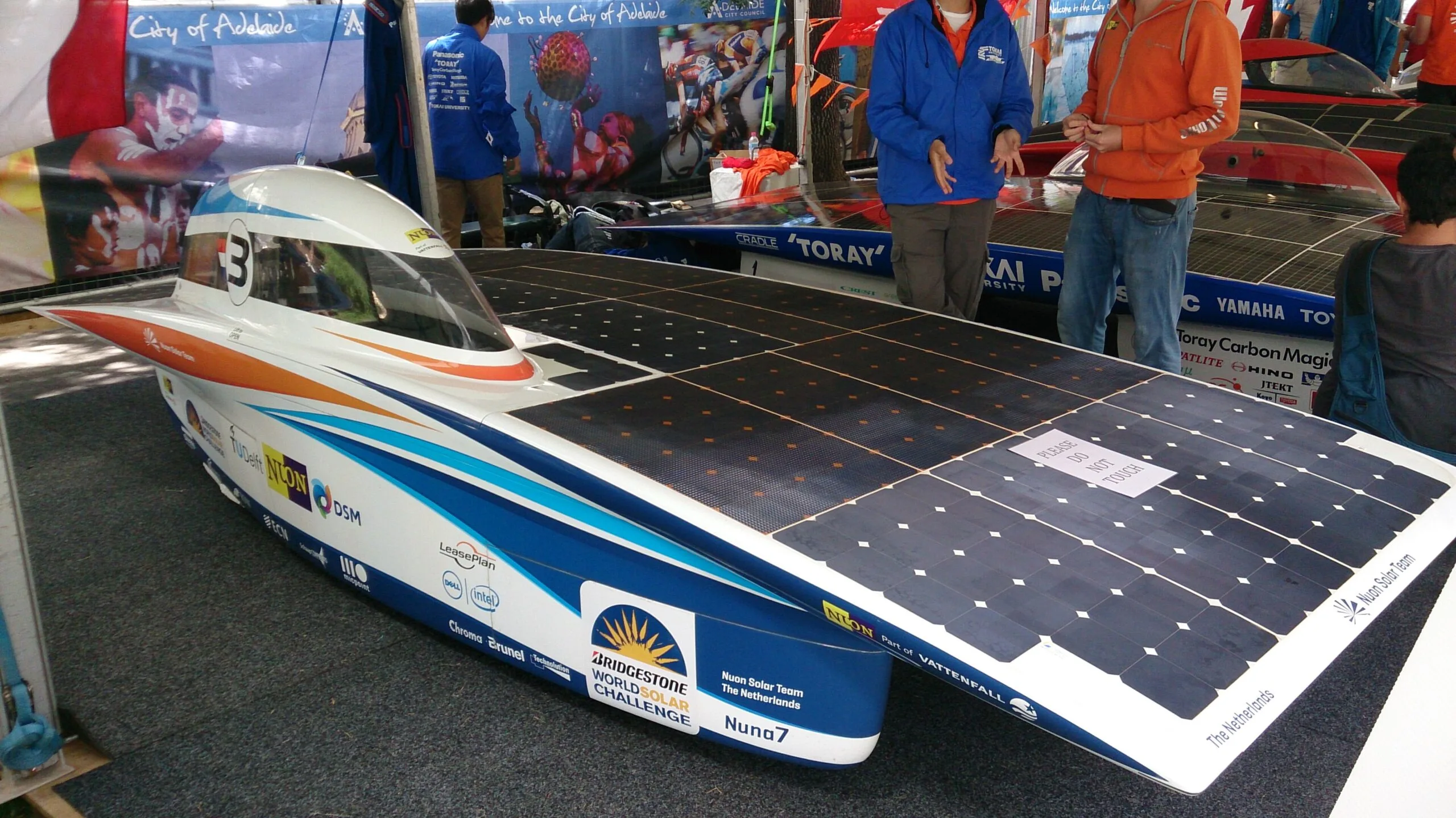
The Nuon Solar Team from Delft University of Technology is the most successful team in World Solar Challenge history. Its Nuna cars won in 2001, 2003, 2005 and 2007, all with sleek three-wheeled designs. Then for 2013 the rules changed: Challenger cars now had to have four wheels and meet stricter safety rules for the driver’s cockpit.
The Delft students answered with Nuna 7. To keep the body as narrow and aerodynamic as possible, they made it asymmetric: the driver sits in a small bubble on the right side of the car instead of in the middle. The car weighs only about 190 kg without driver, and the team also used solar concentrators to squeeze more energy out of the light, even when the sun was not at its strongest.
In October 2013 Nuna 7 crossed Australia, about 3,000 km from Darwin to Adelaide, at an average of about 91 km/h (57 mph) and won. It was Delft’s fifth World Solar Challenge title. The team went on to win again in 2015 and 2017 with Nuna 8 and Nuna 9.
Technical data
| Builder | Nuon Solar Team, Delft University of Technology (NL) |
|---|---|
| Layout | Four wheels (new 2013 rule), asymmetric body with driver on the right |
| Weight | ~190 kg without driver |
| Solar | Silicon array with optical concentrators |
| Result | Winner, Bridgestone World Solar Challenge 2013, Ø ~91 km/h over ~3,000 km |
| Team record | WSC wins 2001, 2003, 2005, 2007, 2013, 2015, 2017, 2025 |
Photo: GTHO / Wikimedia Commons, CC BY-SA 3.0
Sources: Wikipedia: Nuna 7 · CleanTechnica (2013) · Wikipedia: Nuon Solar Team