
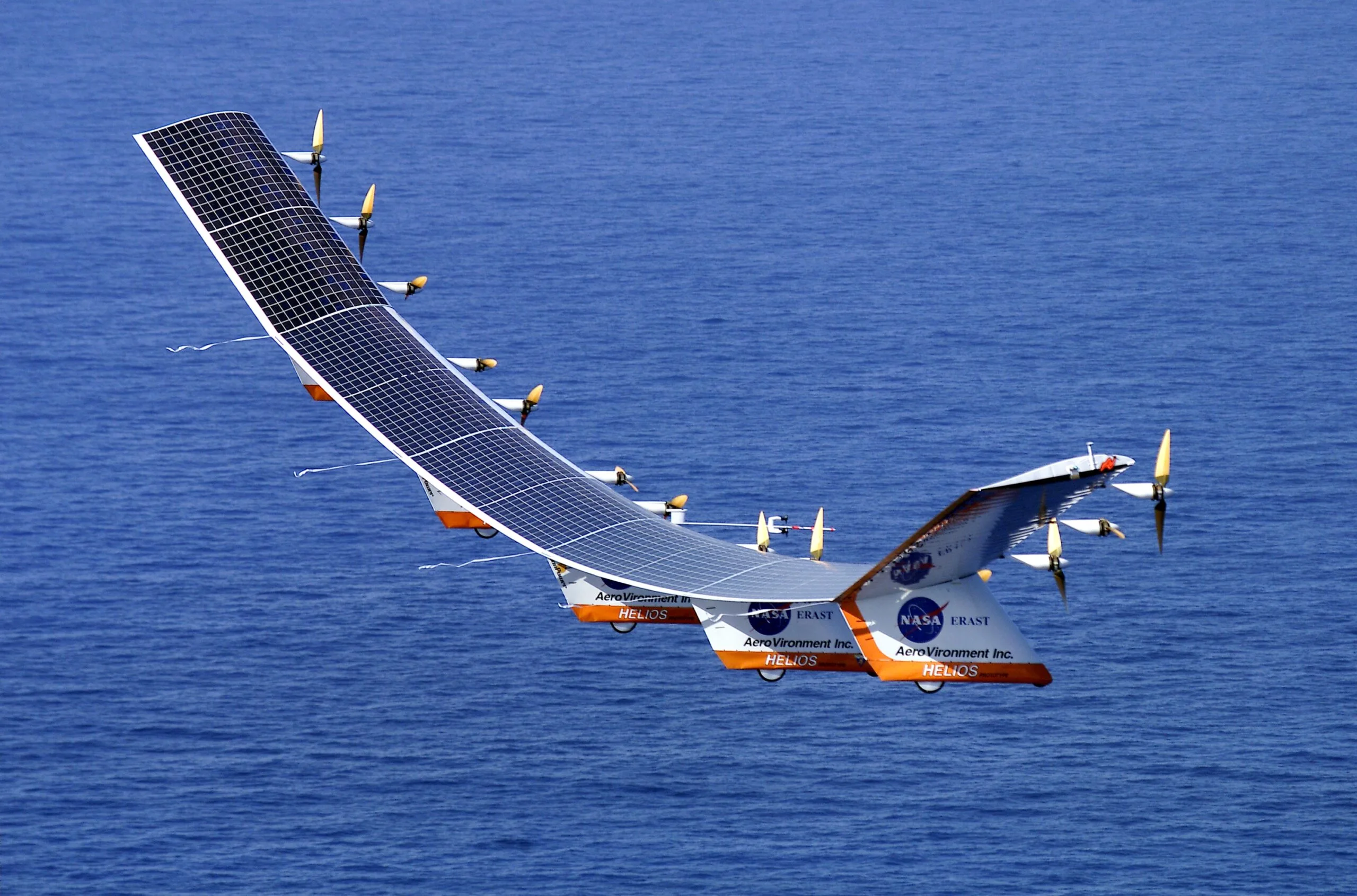
Picture a wing longer than a jumbo jet’s, as thin as a surfboard, covered in solar cells and driven by fourteen small propellers. That was Helios, the last and largest of a family of solar aircraft built by AeroVironment for NASA’s Environmental Research Aircraft and Sensor Technology (ERAST) program.
The family started with Pathfinder (29.5 m, 7.5 kW of solar), which reached 15,000 m in 1995. It grew into Pathfinder-Plus (36.3 m, 12.5 kW) and the 61.8 m Centurion, and ended with the Helios Prototype: a 75.3 m (247 ft) wingspan, 14 electric motors, roughly 35 kW of solar output, and a maximum weight of only 929 kg.
On 13 August 2001, flying remotely from Kauai, Hawaii, Helios climbed to 96,863 ft (29,524 m), a world altitude record for a winged aircraft in sustained horizontal flight that wasn’t rocket powered. At that height the air is so thin that the wing behaves almost as it would on Mars.
The next goal was to fly through the night on stored energy, a key step toward “eternal” solar aircraft. During a test flight on 26 June 2003, the ultra-light wing hit turbulence, deformed and broke up over the Pacific. Helios was lost, but its lessons shaped every solar high-altitude aircraft since, from Solar Impulse to today’s stratospheric “pseudo-satellites”.
Technical data
| Builder | AeroVironment, Inc. (USA) for NASA ERAST |
|---|---|
| Type | Unmanned, remotely piloted solar-electric flying wing |
| Wingspan | 75.3 m (247 ft) |
| Motors | 14 electric motors |
| Solar | ~35 kW array across the upper wing surface |
| Max weight | 929 kg (2,048 lb) |
| Record | 29,524 m (96,863 ft), 13 August 2001 |
| Fate | Broke up in turbulence over the Pacific, 26 June 2003 |
| Predecessors | Pathfinder (1995), Pathfinder-Plus (80,201 ft, 1998), Centurion |
Photo: NASA / Wikimedia Commons, Public domain
Sources: Wikipedia: NASA Pathfinder / Helios