
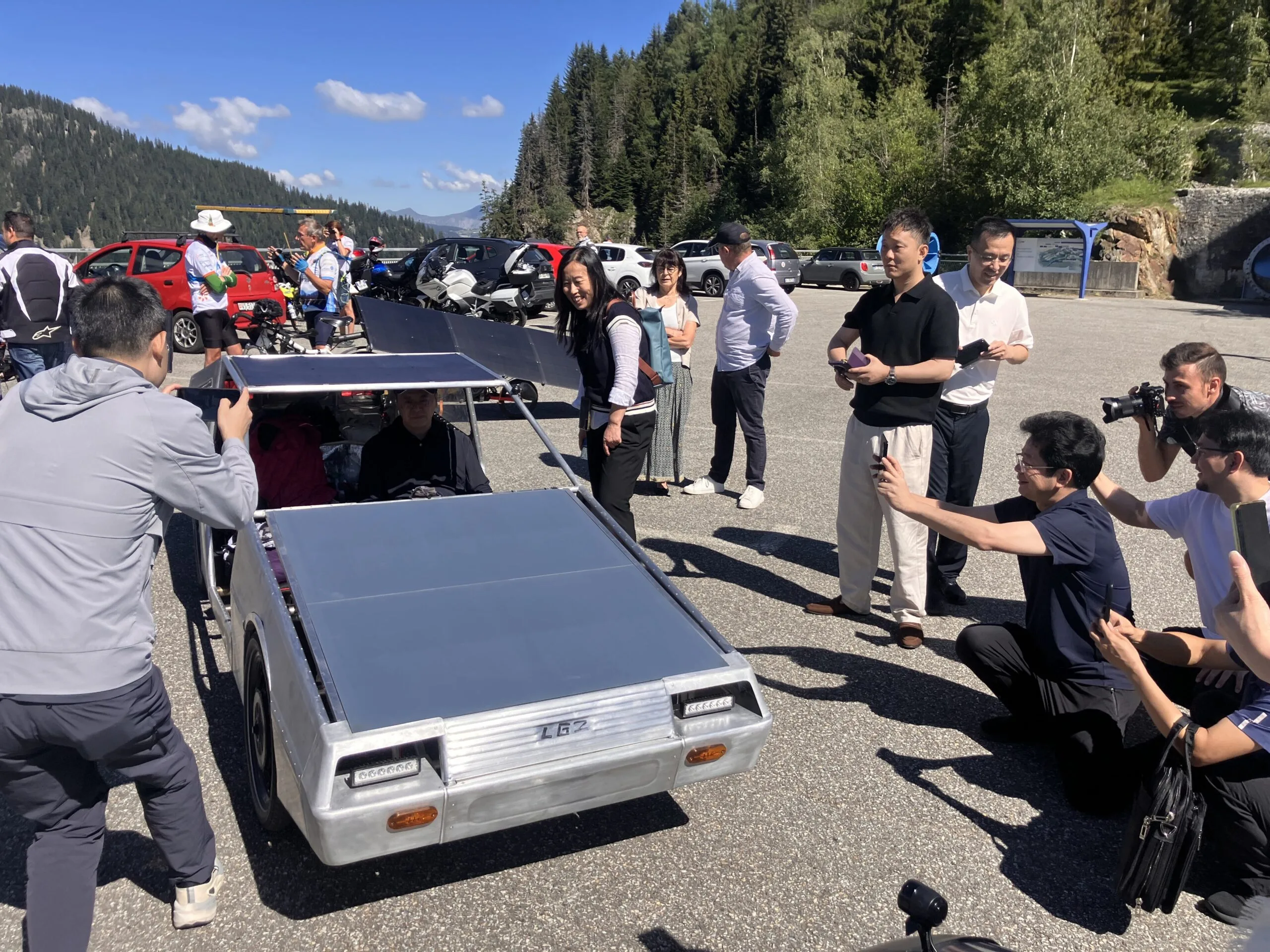
Most solar tandems put one rider behind the other on a tall, tippy frame. Olivier wanted something else: a vehicle where two people pedal side by side, can talk naturally, and feel completely safe, even when stopped. His previous solar tandem was technically impressive, but its high centre of gravity and heavy solar roof scared his wife after one ride.
So he wrote a brutal list of requirements: a true tandem, stable at rest, side-by-side seats, easy to get in and out of for any age, ≤ 150 kg with luggage, assistance up to 45 km/h, and enough flat surface for genuine solar autonomy. The breakthrough question: what is the flattest, most iconic car body ever built, one where a solar panel would feel at home? The answer was the DeLorean from Back to the Future. The name VéLorean (vélo + DeLorean) was suggested by Olivier’s youngest son.
The vehicle was designed and hand-built by the French workshop LGZ.bike and its master builder Dom: a lightweight steel quad chassis with an aluminium body, less than 1.20 m wide and under 150 kg. The broad, flat body carries about 500 Wp of solar panels. The top and back panels use the latest-generation Maxeon cells, while the front panels were custom-made by Mito Solar in a light-grey film to match the bodywork. Two Grin MAX45 direct-drive hub motors, one in each front wheel, give high torque in the mountains and back-pedal-controlled regenerative braking. Because no insurer would cover the L6e version, the assist was limited to 25 km/h to stay in the e-bike (EPAC) category.
In June and July 2026, Olivier and his mother Chantal (72, living with a neuroendocrine tumour) rode it on the Sun Trip Auvergne-Rhône-Alpes: more than 1,300 km and 20,000 m of climbing in two weeks, including the Galibier pass, fully on solar energy. With rider weights and luggage the vehicle weighed close to 300 kg, the heaviest in the field. Yet it averaged a net 21 Wh/km. The sun supplied about 30 kWh for the whole trip, less than the primary energy in three litres of diesel.
Technical data
| Builder | LGZ.bike (France), master builder Dom; electric drive configured by GrinTech (grintech.eu) |
|---|---|
| Riders | Olivier and his mother Chantal (72) |
| Type | Two-seat, side-by-side recumbent pedal quadricycle (tandem) |
| Chassis / body | Steel quad chassis, aluminium body; < 1.20 m wide, < 150 kg |
| Solar | ~500 Wp: Maxeon-cell panels on top and back + custom Mito Solar front panels |
| Motors | 2 × Grin MAX45 direct-drive front hub motors, regenerative braking |
| Assist limit | 25 km/h (EPAC); designed for up to 45 km/h (L6e) |
| Efficiency | 21 Wh/km net average; ~30 kWh of solar energy over the whole trip |
| Trip | Sun Trip AURA 2026: 1,300+ km, 20,000+ m climbing, 100% solar |
Photo (Sun Trip 2026): ShawnRyan1979 / Wikimedia Commons, CC0
Sources: Grin Technologies project gallery · velorean.bike · Sun Trip AURA 2026