
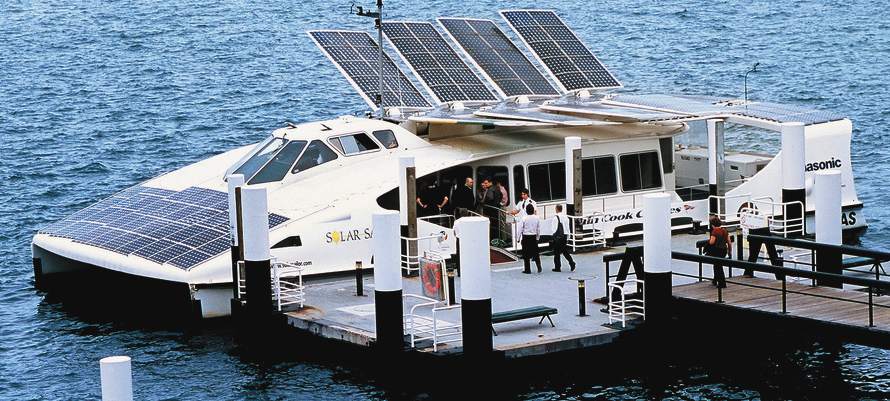
What if a sail could also be a solar panel? Sydney doctor Robert Dane was so taken by this idea that he gave up general practice to build it. In 1999 he founded Solar Sailor, and with a A$1 million government grant built a A$3 million ferry in time for the Sydney 2000 Olympic Games.
The result is a 21-metre catamaran for up to 100 passengers, with eight movable “solar wings” mounted above the cabin plus more panels at the front. The wings are covered in solar cells and can be rotated and tilted: flat toward the sun to collect energy, or turned into the wind to act as rigid sails. Folded down, they get out of the way in strong winds.
On sunlight alone the ferry cruises at around 7 knots in full sun and 3–4 knots under cloud. Adding the wind lets it go faster without using more stored energy.
The “solar wing” idea outgrew ferries. Solar Sailor became Ocius Technology in 2014 and now builds Bluebottle uncrewed ocean drones. They use the same combination of solar, wind and wave power to stay at sea for months.
Technical data
| Inventor / builder | Robert Dane, Solar Sailor (Sydney), founded 1999 |
|---|---|
| Type | Hybrid solar-electric/wind catamaran ferry |
| Length | 21 m |
| Passengers | Up to 100 |
| Solar wings | 8 movable wings over the cabin + panels at the bow, also used as rigid sails |
| Speed | ~7 kn in full sun, 3–4 kn overcast |
| Built for | Sydney 2000 Olympics (A$3 million, A$1 million federal grant) |
| Today | Company renamed Ocius Technology (2014), builds Bluebottle ocean drones |
Photo: CB Researcher / Wikimedia Commons, CC0
Sources: The Naked Scientists · Bay Crossings · Wikipedia: Ocius Technology