
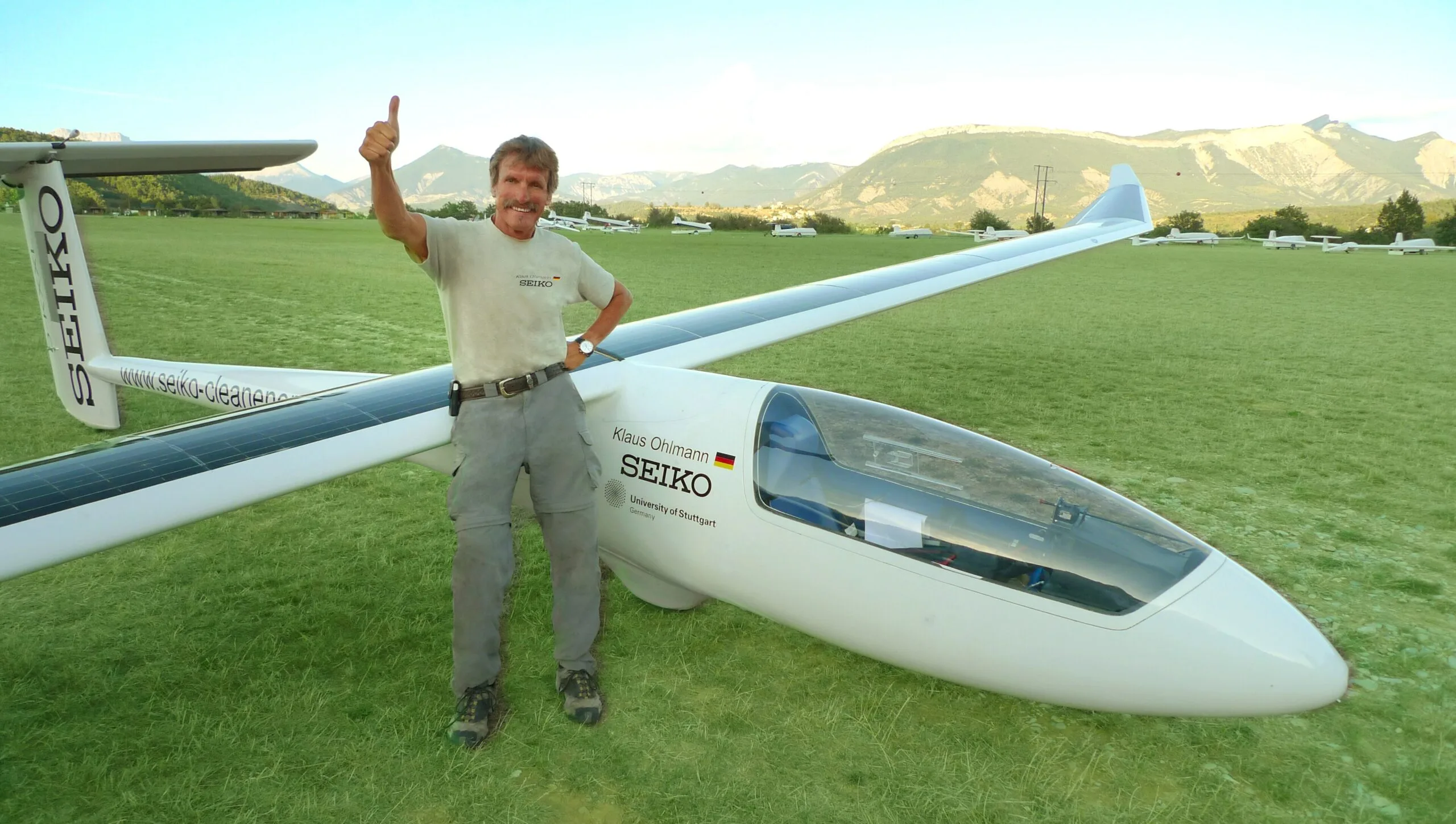
A glider is already the most efficient aircraft there is, so what happens when you add solar cells? The aerospace engineers at the University of Stuttgart found out with icaré 2, a single-seat motor glider whose wing and tail are covered with photovoltaic cells.
Designed from 1994, icaré 2 has a 25 m wingspan and 25 m² of wing area, all built from carbon-fibre composites. Empty, the glider weighs about 208 kg (458 lb); batteries, motor, propeller and solar cells add another ~69 kg. The electric motor drives a large, folding two-blade propeller mounted on top of the fin as a pusher, almost silent in flight. It takes off from a runway at around 90 km/h and climbs at about 2 m/s under power.
In 1996 icaré 2 won the Berblinger Prize, a competition for practical solar aircraft offered by the city of Ulm. Fifteen years later, in 2011, record glider pilot Klaus Ohlmann (pictured) took it to the Alps of southern France and set two solar-flight records: a 384.4 km out-and-return flight on 17 August and a 439.3 km flight via three turn points on 10 September.
The project was supported by the Japanese watchmaker Seiko, whose logo you can see on the fuselage. The same Stuttgart institute later built the e-Genius electric aircraft.
Technical data
| Builder | Institute of Aircraft Design (IFB), University of Stuttgart; sponsor Seiko |
|---|---|
| Type | Single-seat solar-electric motor glider |
| Wingspan | 25 m (82 ft), wing area 25 m² |
| Weight | ~208 kg empty + ~69 kg for batteries, motor, propeller and solar cells |
| Solar | Photovoltaic cells across wing and tail surfaces |
| Propulsion | Electric motor, folding 2-blade pusher propeller on top of the fin |
| Award | Berblinger Prize (Ulm), 1996 |
| Records | 2011, pilot Klaus Ohlmann: 384.4 km out-and-return; 439.3 km via 3 waypoints |
Photo (Klaus Ohlmann with icaré 2): PLANETAIRE / Wikimedia Commons, Copyrighted free use
Sources: Sustainable Skies · Flight International · Akaflieg Stuttgart