
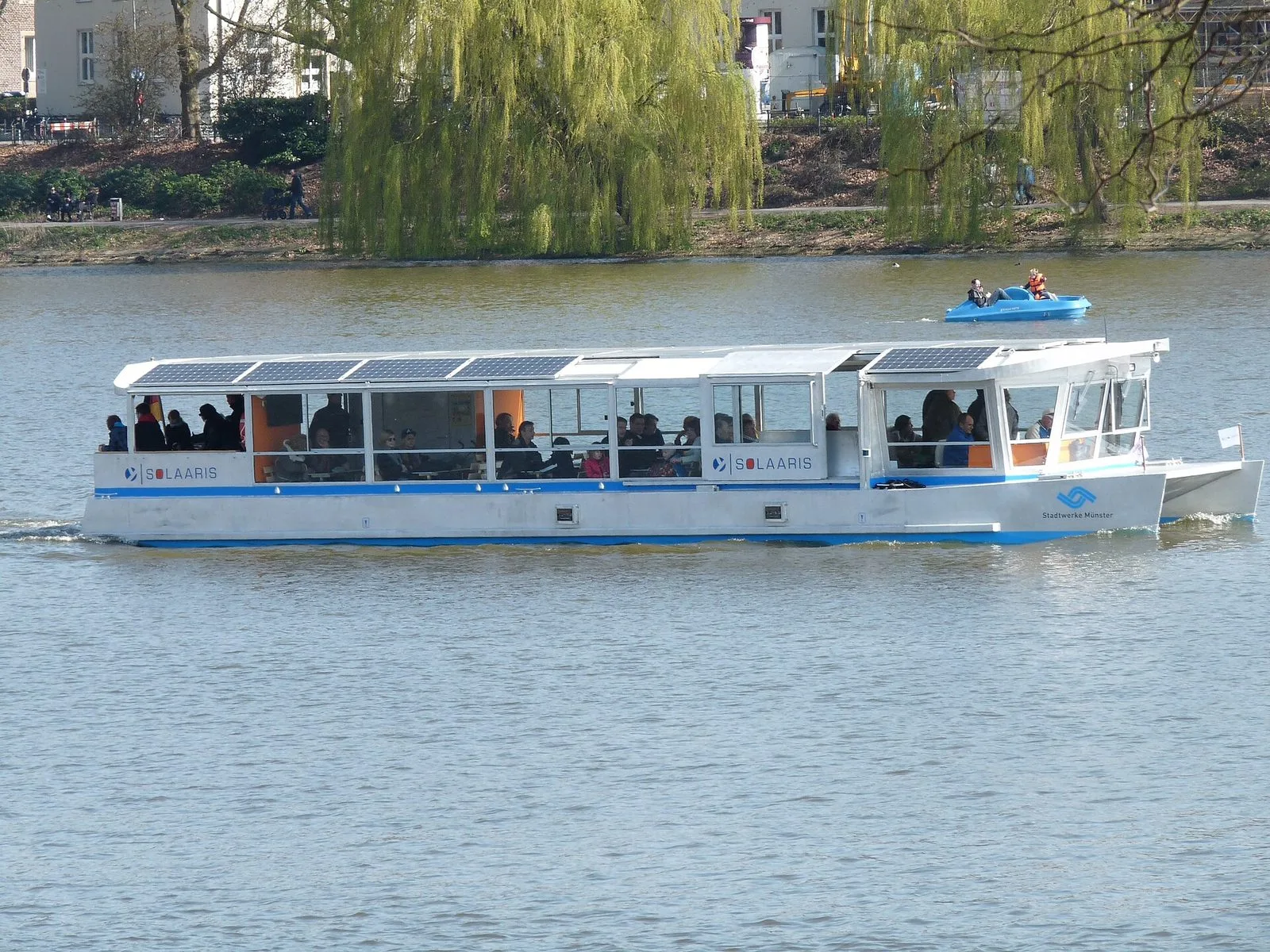
Münster is Germany’s bicycle capital, so it fits that its lake has a solar water bus. On the Aasee, close to the city centre, the catamaran Solaaris has been carrying passengers since 2012.
Its predecessor was a conventional water bus that carried about 400,000 passengers in 36 years. In 2009 it was fitted with 7 m² of solar cells to cover part of its energy use. In November 2011 it made its last trip. Its successor was built at the Ostseestaal yard in Stralsund, the builders of Berlin’s FährBär ferries, in only 70 days. Solaaris made its maiden voyage on the Baltic Sea on 23 March 2012.
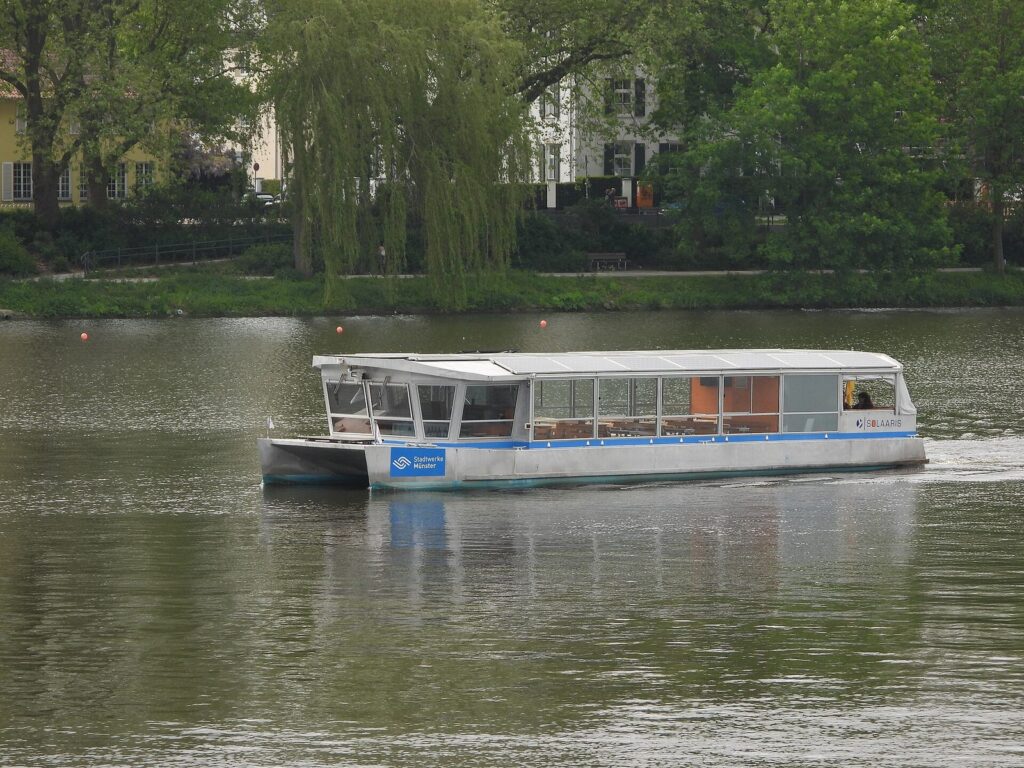
Solaaris is made entirely of aluminium and is just under 16 m long. It is barrier-free and takes 68 passengers. Two electric motors push it up to 9.8 km/h; the usual speed is 7 km/h. At full load the motors are only about 55 decibels loud, roughly the level of a quiet conversation. Remarkably, Solaaris has no backup engine: it relies completely on its electric drive and lithium-ion batteries.
The boat cost about €500,000, of which about €200,000 went into the battery system. The city’s utility, Stadtwerke Münster, contributed €55,000 in 2012. It is a good example of what battery prices meant then and how much they have fallen since; read Battery Prices Hit a Record Low.
Technical data
| Builder | Ostseestaal, Stralsund (Germany), built in 70 days |
|---|---|
| In service | Since 2012, Aasee, Münster |
| Hull | Aluminium catamaran, just under 16 m |
| Capacity | 68 passengers, barrier-free |
| Drive | 2 electric motors, 9.8 km/h max., 7 km/h service, ~55 dB at full load |
| Energy | Solar + lithium-ion batteries, no backup engine |
| Cost | ~€500,000 (batteries ~€200,000) |
Photos
- Top photo: WIKImaniac / Wikimedia Commons, CC BY-SA 3.0
- Solaaris on the Aasee in May 2023. Photo: Molgreen / Wikimedia Commons, CC BY-SA 4.0
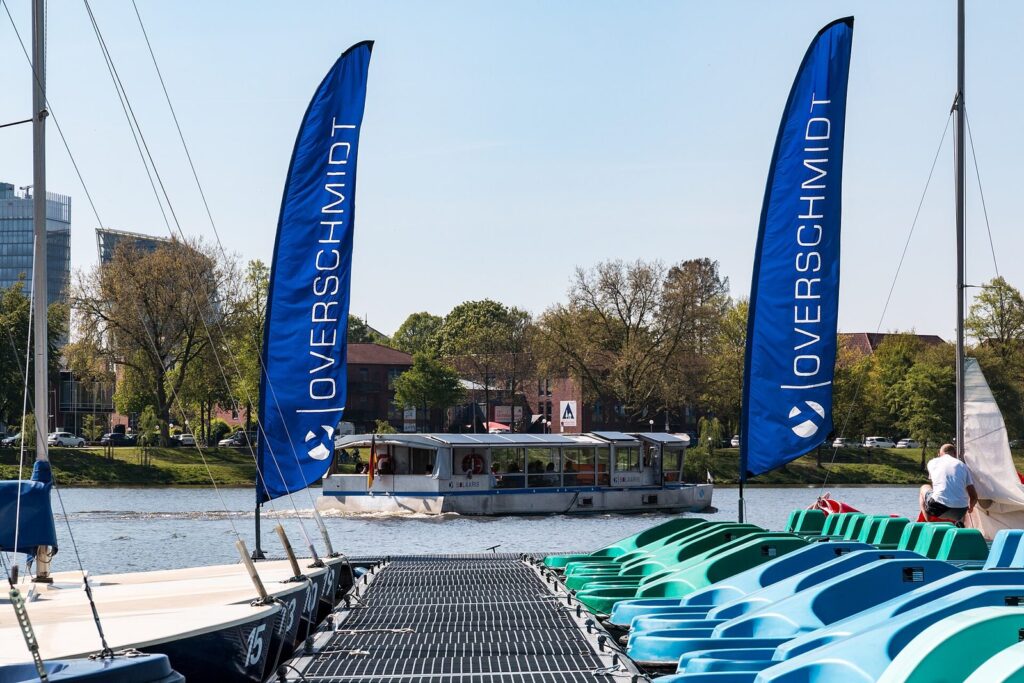
- The landing stage at the Aasee, with Solaaris in the backgro… Photo: Dietmar Rabich / Wikimedia Commons, CC BY-SA 4.0