
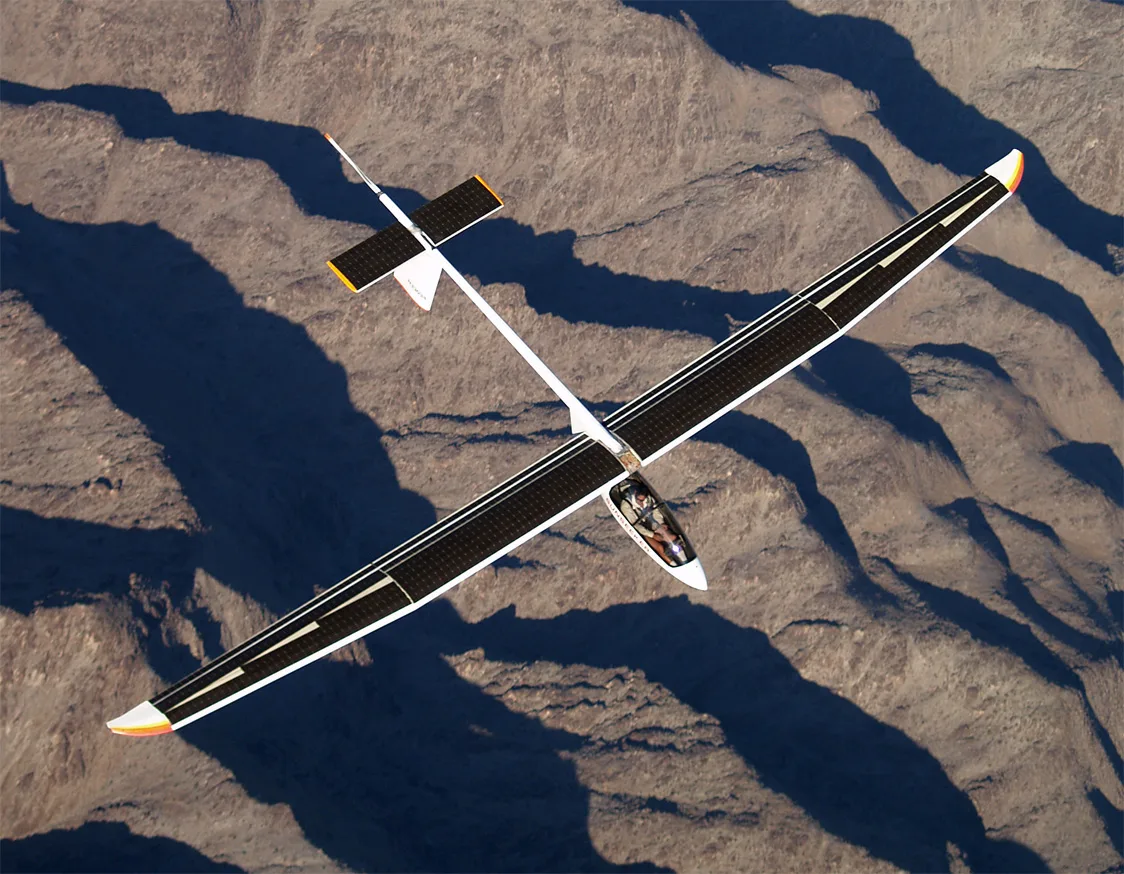
Long before Solar Impulse, one man was quietly flying solar planes he had built himself. Eric Raymond, a hang-gliding pioneer from California, founded Solar Flight and spent decades refining a family of slender, single-seat solar aircraft called Sunseeker.
The first Sunseeker crossed the United States in 1990, hopping from San Diego, California to Kitty Hawk, North Carolina in 21 flights and about 121 hours in the air. Raymond then rebuilt the plane almost completely. Sunseeker II got a new wing, motor, propeller, tail, electronics and lithium-polymer batteries, and 1,510 solar cells on its folding wings.
On 14 April 2009 Raymond took off from Buttwil in Switzerland and, five hours later, landed in Turin, Italy: the first crossing of the Alps by a solar-powered aircraft. On the way he climbed to 13,700 ft (4,175 m) on direct solar power.
Raymond and his wife Irena later built the two-seat Sunseeker Duo. Their work shows that solar flight does not need a billion-euro programme, just patience, light materials and a lot of sunshine.
Technical data
| Builder / pilot | Eric Raymond, Solar Flight (California) |
|---|---|
| Type | Single-seat solar-electric aircraft with folding wings |
| Solar | 1,510 solar cells |
| Batteries | Lithium-polymer |
| Sunseeker I | 1990 crossing of the USA, San Diego → Kitty Hawk, 21 flights, ~121 flight hours |
| Alps crossing | 14 April 2009, Buttwil (CH) → Turin (IT), ~5 h, max. 13,700 ft |
| Successor | Sunseeker Duo (two-seater) |
Photo: Ccoonnrraadd / Wikimedia Commons, CC BY-SA 3.0
Sources: AVweb · FAI · Solar Flight