
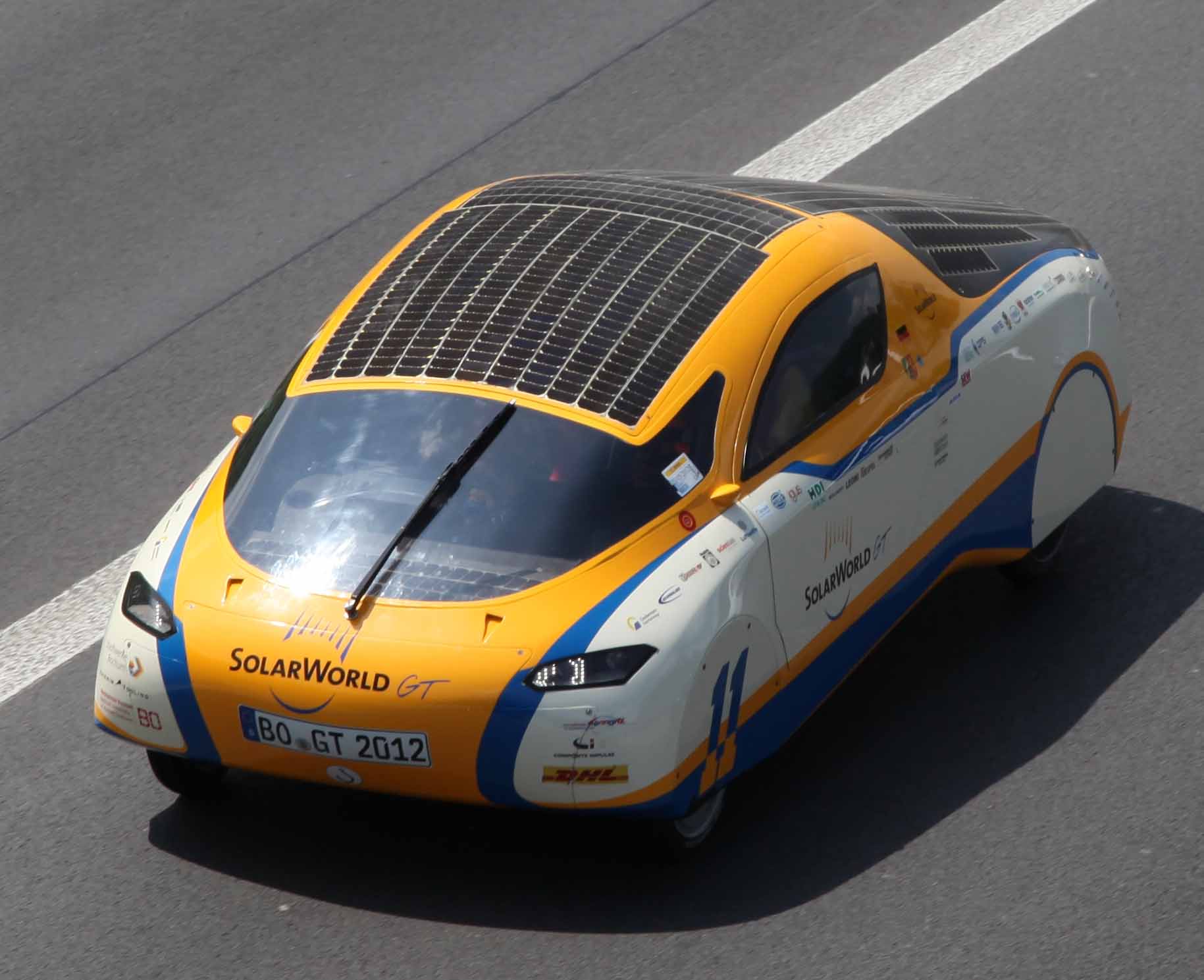
Most solar cars race for a week and then go to a museum. The students of Hochschule Bochum had a bigger plan for their fourth solar vehicle: drive it around the world.
The SolarWorld GT was their first car approved for public roads, as an EU L7e light vehicle. It is a two-seater, 4.1 m long and 1.6 m wide, and weighs only about 300 kg. The roof holds 3 m² of high-efficiency cells (29.2%) producing about 823 W. Two battery packs with about 9.8 kWh give around 400 km of range without any sun, and the car can exceed 100 km/h.
The world tour started on 26 October 2011 after the World Solar Challenge in Australia. From there it went through New Zealand and across the USA, then shipped to Europe for the longest leg of 15,000 km from Italy through France, Germany, Central Europe, Romania, Moldova and Ukraine to Russia. It ended back in Australia on 13 December 2012.
In total the car covered 29,753 km in 14 countries, about 130 km per day. It was recognised as the longest journey ever made by a solar vehicle.
Technical data
| Builder | Students of Hochschule Bochum (Germany) |
|---|---|
| Type | Two-seat road-legal solar car (EU L7e) |
| Size / weight | 4.1 × 1.6 m, ~300 kg |
| Solar | 3 m², 29.2% efficiency, ~823 W |
| Battery | 2 packs, ~9.8 kWh total, ~400 km without sun |
| Top speed | > 100 km/h |
| World tour | 26 Oct 2011 – 13 Dec 2012, 29,753 km, 14 countries, Ø 130 km/day |
Photo: SolarLabor / Wikimedia Commons, CC BY-SA 3.0
Sources: Wikipedia (de): SolarWorld GT