
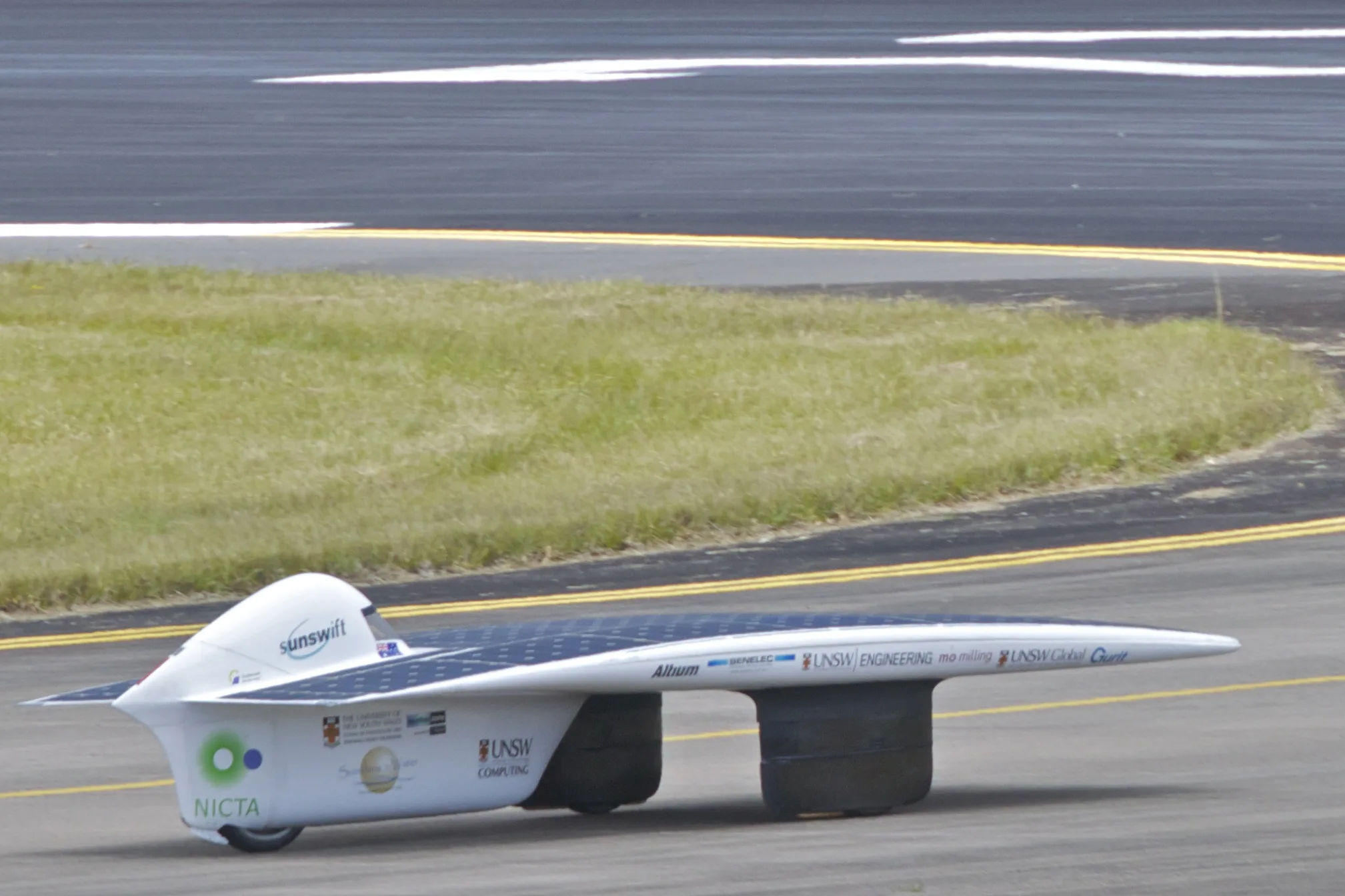
How fast can a car go on sunlight alone, with no battery at all? In January 2011 the students of UNSW Sunswift in Sydney set out to answer that, and earned a Guinness World Record.
Their car, Sunswift IVy, was a low, three-wheeled racer with a carbon-fibre monocoque body. A solar array of about 1,200 W, roughly what a toaster uses, powered a CSIRO-designed 1,800 W brushless motor. Normally IVy carried a 24.75 kg lithium-polymer battery. But the record category is for vehicles powered exclusively by solar cells, so the battery was removed for the attempt.
On the runway of the HMAS Albatross navy air base at Nowra, New South Wales, with Guinness adjudicators watching, IVy reached more than 88 km/h (88.8 km/h). That beat the previous record of 79 km/h. Racing driver Barton Mawer was among the drivers.
IVy had already raced across Australia in the 2009 Global Green Challenge. Its successors include Violet and Sunswift 7, which later set the 1,000 km record on a single charge.
Technical data
| Builder | UNSW Sunswift (University of New South Wales) |
|---|---|
| Type | Single-seat, three-wheeled solar race car |
| Body | Carbon-fibre monocoque |
| Solar | ~1,200 W array |
| Motor | CSIRO brushless 3-phase, 1,800 W |
| Battery | 24.75 kg Li-polymer (removed for the record) |
| Record | Guinness: fastest solar-powered vehicle, 88.8 km/h, January 2011, HMAS Albatross, Nowra |
Photo (record attempt, Nowra): Bradhall71 / Wikimedia Commons, Public domain
Sources: UNSW Newsroom (2011) · pv magazine · The Engineer