
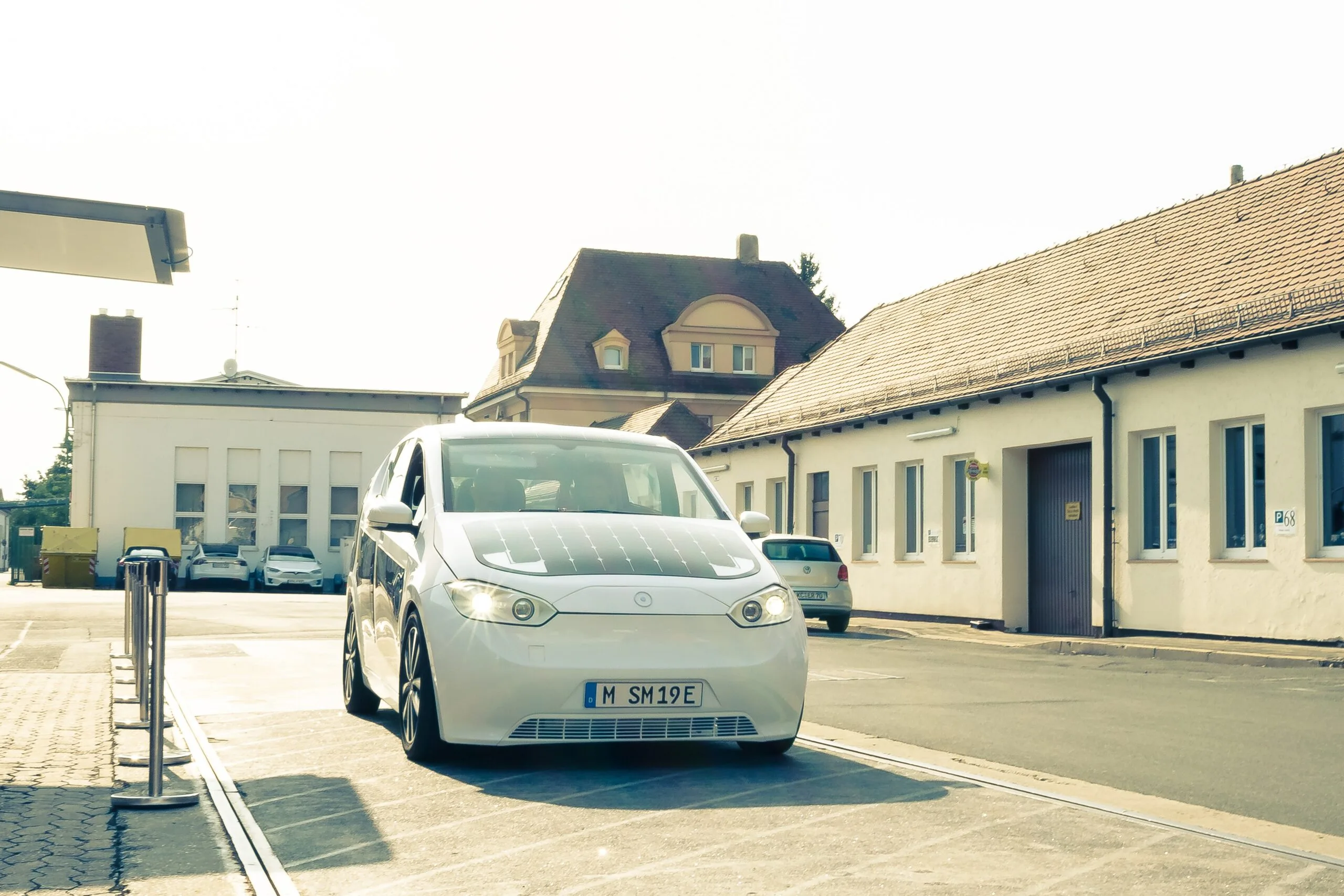
While the Lightyear 0 aimed high, the Sono Sion aimed wide: a practical, affordable family car whose whole body helps charge the battery. It was developed by Sono Motors, a Munich start-up founded by Laurin Hahn and Jona Christians, and largely financed by its future owners through crowdfunding and reservations.
The first prototype was shown in July 2017 (the car pictured here, on a test drive in Nuremberg). The early design had 330 solar cells covered by a light, shatterproof polycarbonate layer instead of glass, good for up to 30 km a day.
The final series design (2022) took this further: 456 solar half-cells seamlessly integrated into roof, bonnet and sides, adding 112 km per week on average and up to 245 km in good conditions. They charged a 54 kWh battery with a 305 km WLTP range. A 120 kW motor gave a top speed of 120 km/h. Thanks to bidirectional charging, the Sion could also power devices up to 2.7 kW from a household socket.
The price was €29,900. But in February 2023, after failing to secure enough funding, Sono Motors ended the Sion program and refocused on selling its solar body-panel technology for buses, trucks and other vehicles. The 18 validation cars it built proved the concept works.
Technical data
| Builder | Sono Motors, Munich (founded by Laurin Hahn and Jona Christians) |
|---|---|
| Solar (2022) | 456 integrated half-cells in polymer body panels; Ø 112 km/week, up to 245 km/week |
| Solar (2017) | 330 cells, up to 30 km/day |
| Battery | 54 kWh (series design) |
| Range | 305 km (WLTP) |
| Motor | 120 kW, 270 Nm, top speed 120 km/h |
| Charging | 75 kW DC, 11 kW AC, bidirectional (up to 2.7 kW out) |
| Price | €29,900 (planned) |
| Status | Program ended February 2023; 18 validation vehicles built |
Photo (2017 prototype): Jakob Härter / Wikimedia Commons, CC BY-SA 2.0
Sources: Electrek (2017 unveil) · The Driven (2022 specs) · pv magazine (2023)