
The University of Michigan Solar Car Team is one of the most successful student teams in solar racing, and Momentum is one of its best-known cars.
For 2005 the team made a bold design change: it went from four wheels to three. Their studies showed that at highway speeds about 70% of a solar car’s energy losses come from aerodynamic drag, so a narrower, slipperier three-wheel shape was worth it. The body is built from carbon fibre and Kevlar composites and measures about 5.0 × 1.8 m (16.4 × 5.9 ft), only 1.1 m high. It is covered with about 3,000 space-grade gallium-arsenide solar cells, and the car weighs under 700 lb (≈ 320 kg).
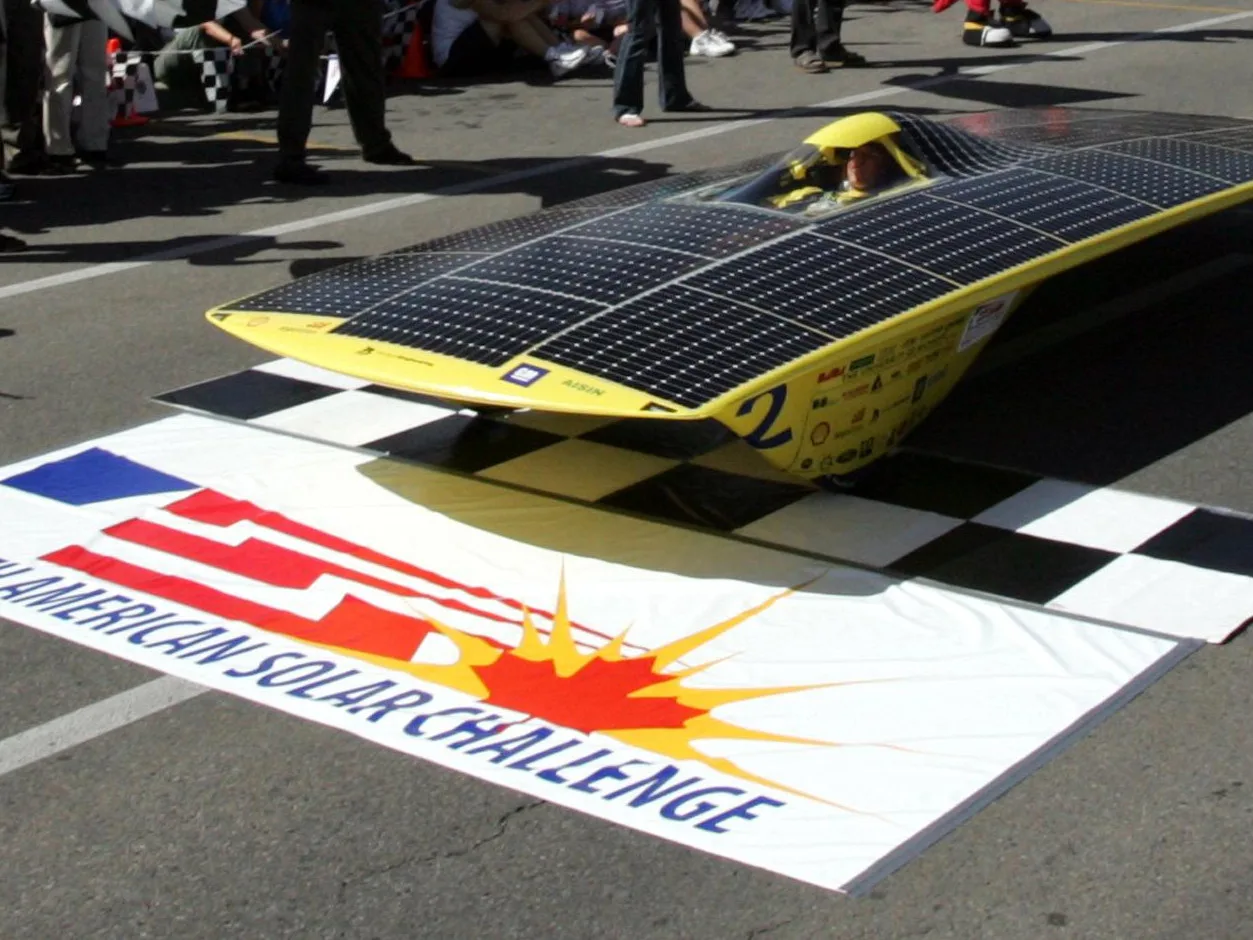
In July 2005 Momentum entered the North American Solar Challenge: a 10-day race of about 2,500 miles (4,000 km) from Austin, Texas along US Route 75 and the Trans-Canada Highway to Calgary, Alberta. Momentum won at an average of 46.2 mph (74 km/h), less than 12 minutes ahead of the University of Minnesota after around 53 hours of racing. The photo shows it crossing the finish line in Calgary.
A few months later the same car finished third at the World Solar Challenge in Australia. Momentum is now on display at the LeMay – America’s Car Museum in Tacoma, Washington.
Technical data
| Builder | University of Michigan Solar Car Team (students) |
|---|---|
| Layout | 3 wheels (changed from 4 to reduce drag) |
| Body | Carbon fibre and Kevlar, ~16.4 × 5.9 × 3.6 ft |
| Solar | ~3,000 space-grade GaAs cells |
| Weight | < 700 lb (≈ 320 kg) |
| Results | North American Solar Challenge 2005 winner (Austin → Calgary, ~2,500 mi, Ø 46.2 mph); World Solar Challenge 2005: 3rd |
| Today | LeMay – America’s Car Museum, Tacoma |
Photo (NASC 2005 finish, Calgary; cropped): United States Department of Energy / Wikimedia Commons, Public domain
Sources: U-M Solar Car Team: 2005 · Wikipedia: NASC 2005 · Electronic Design