
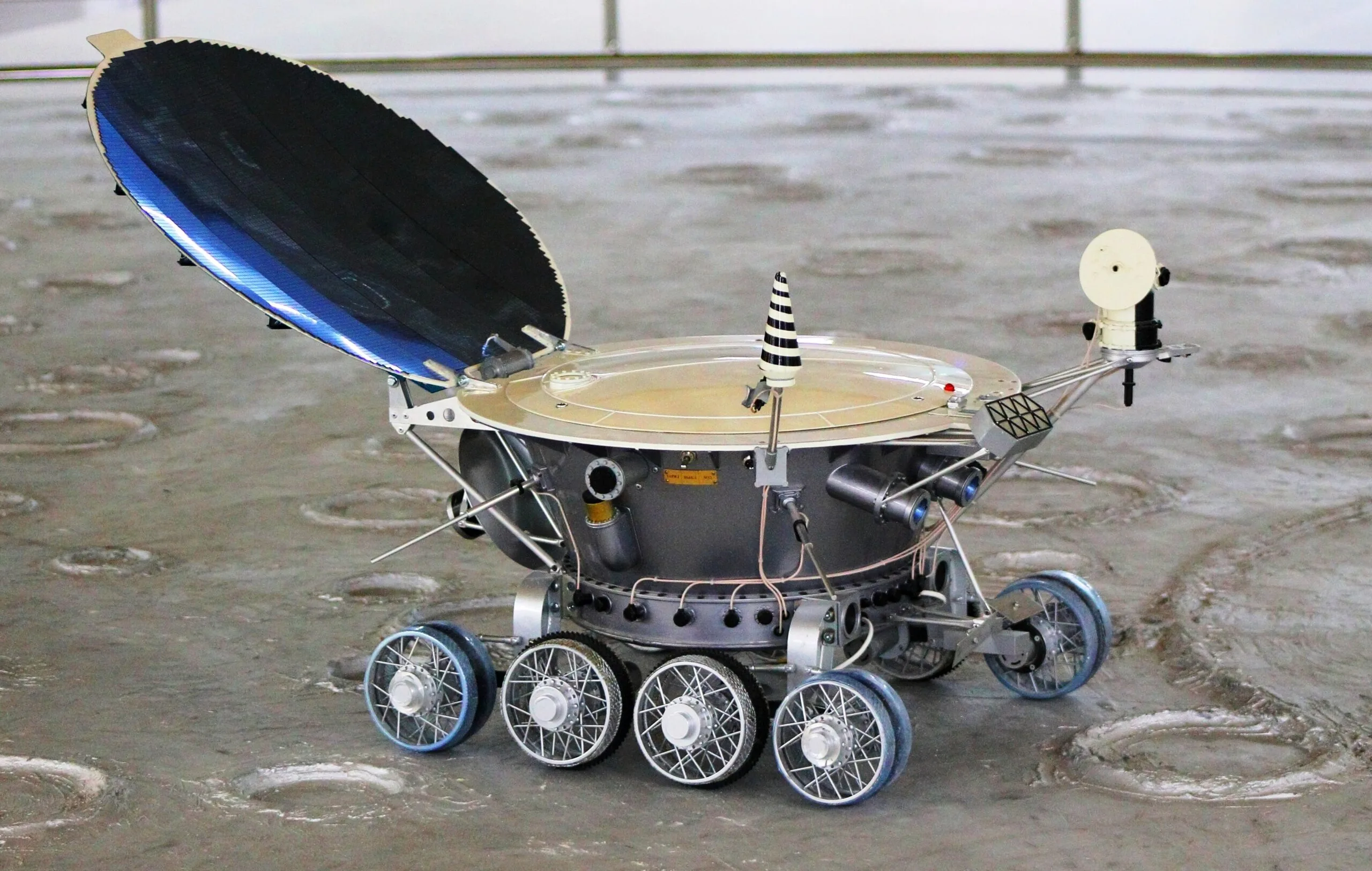
Long before Mars rovers, the first remote-controlled vehicle to drive on another world was solar-charged. Lunokhod 1 (“moon walker”) landed in the Mare Imbrium on 17 November 1970 aboard the Soviet Luna 17 lander and rolled down a ramp onto the Moon.
It was designed by the Lavochkin design bureau under chief designer Alexander Kemurdzhian. The rover looked like a bathtub on eight independently driven wheels, about 1.7 m long and 1.6 m wide, with a mass of 840 kg. Its most recognisable feature is the hinged lid. The solar array was mounted on the underside, and during the two-week lunar day the lid opened to recharge the batteries. During the freezing lunar night the lid closed, and a polonium-210 heater kept the electronics warm.
A small crew on Earth drove it by television pictures, with a radio delay of several seconds. Designed for three months, Lunokhod 1 kept working for eleven lunar days (321 Earth days). It drove 10.54 km, sent back more than 20,000 TV images and 206 panoramas, and tested the lunar soil at hundreds of locations.
Contact was lost in September 1971. Its French-built laser retroreflector is still on the Moon, and scientists have bounced lasers off it since it was rediscovered in 2010.
Technical data
| Builder | Lavochkin design bureau, chief designer Alexander Kemurdzhian (USSR) |
|---|---|
| Landing | 17 November 1970, Mare Imbrium (Luna 17) |
| Wheels | 8, each independently driven |
| Size / mass | ~1.7 × 1.6 m, height 1.35 m, 840 kg |
| Power | Solar array under the hinged lid recharging batteries; Po-210 heater for the lunar night |
| Distance | 10.54 km |
| Mission | 11 lunar days (321 Earth days), design life 3 months |
| Data returned | 20,000+ TV images, 206 panoramas |
Photo (model): Sergei Kazantsev / Wikimedia Commons, CC BY-SA 4.0
Sources: Wikipedia: Lunokhod 1