
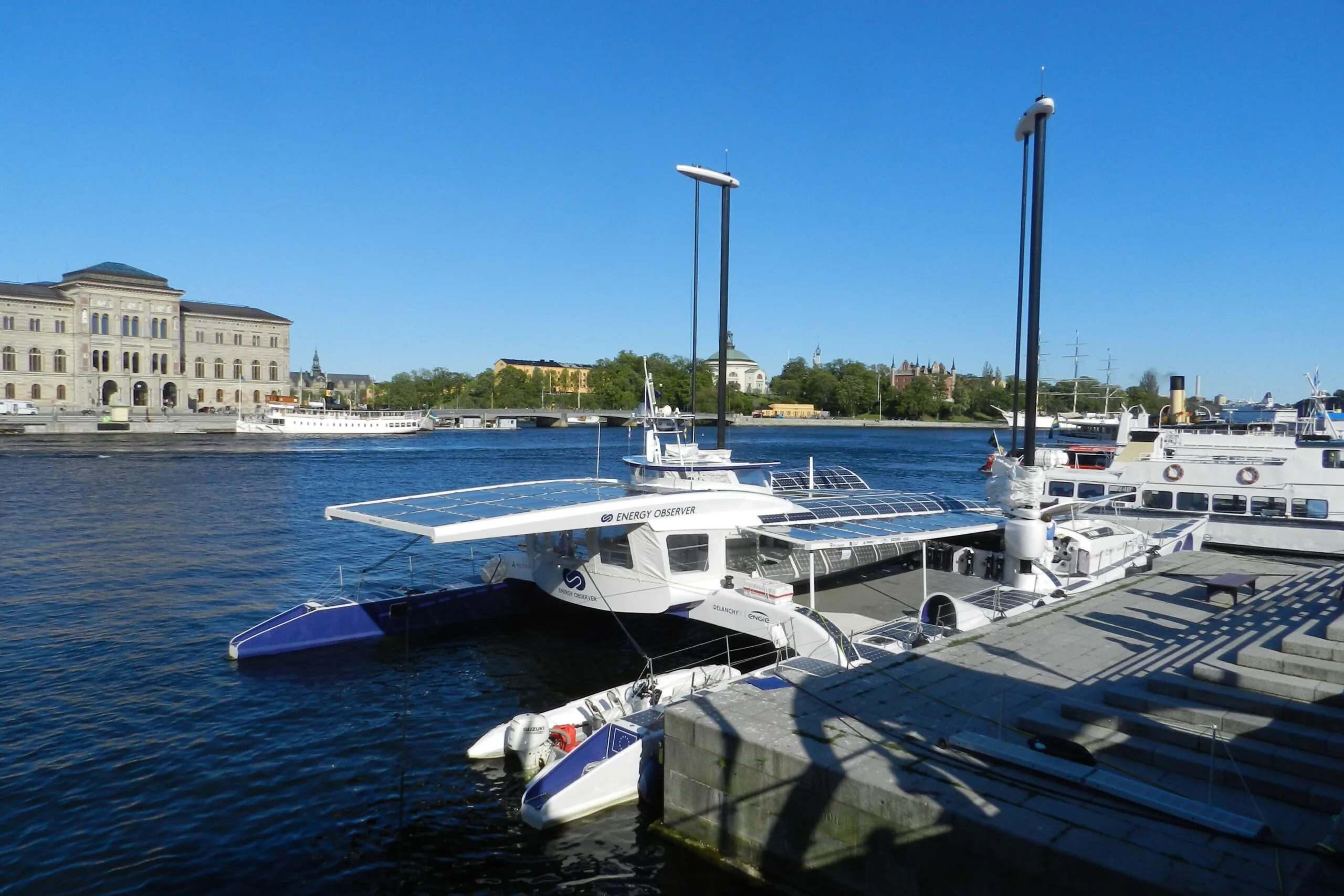
Where PlanetSolar proved that solar power alone can cross oceans, Energy Observer asked the next question: what if a boat could make all its own energy, every day and every night, with no fuel at all?
The hull has a famous history. It was built in Canada in 1983 by naval architect Nigel Irens for sailor Mike Birch. As Formule TAG, it was the first racing sailboat to break 500 miles in 24 hours. In 2017 offshore racer Victorien Erussard and documentary maker Jérôme Delafosse relaunched it as a 30.5 m floating laboratory.
The energy system combines three sources and two kinds of storage. 130 m² of solar panels (21 kWp) of three different types cover the deck, joined by two vertical-axis wind turbines and a traction kite. Short-term energy goes into a 106 kWh lithium battery. Surplus power desalinates and splits seawater into hydrogen (up to 62 kg on board), which a 22 kW fuel cell turns back into electricity at night or in bad weather. Two reversible 41 kW motors can even work as hydro-generators while sailing.
The boat left Saint-Malo in 2017 for a multi-year odyssey with the goal of visiting 50 countries and 101 ports, cruising at 8–10 knots and testing every technology in real conditions.
Technical data
| Team | Victorien Erussard (captain, founder) and Jérôme Delafosse (expedition leader) |
|---|---|
| Hull | Ex-racing catamaran Formule TAG, Nigel Irens, 1983 (Canada) |
| Size / weight | 30.5 × 12.8 m, ~28 t |
| Solar | 130 m², 3 panel types, 21 kWp |
| Wind | 2 vertical-axis turbines (2 × 1 kW) + traction kite |
| Battery | 106 kWh lithium-ion |
| Hydrogen | Up to 62 kg made from seawater on board; 22 kW fuel cell |
| Motors | 2 × 41 kW reversible (also hydro-generators) |
| Speed | 8–10 kn cruising |
Photo (Stockholm, 2019): Zquid / Wikimedia Commons, CC BY-SA 4.0
Sources: Wikipedia: Energy Observer · Practical Sailor