
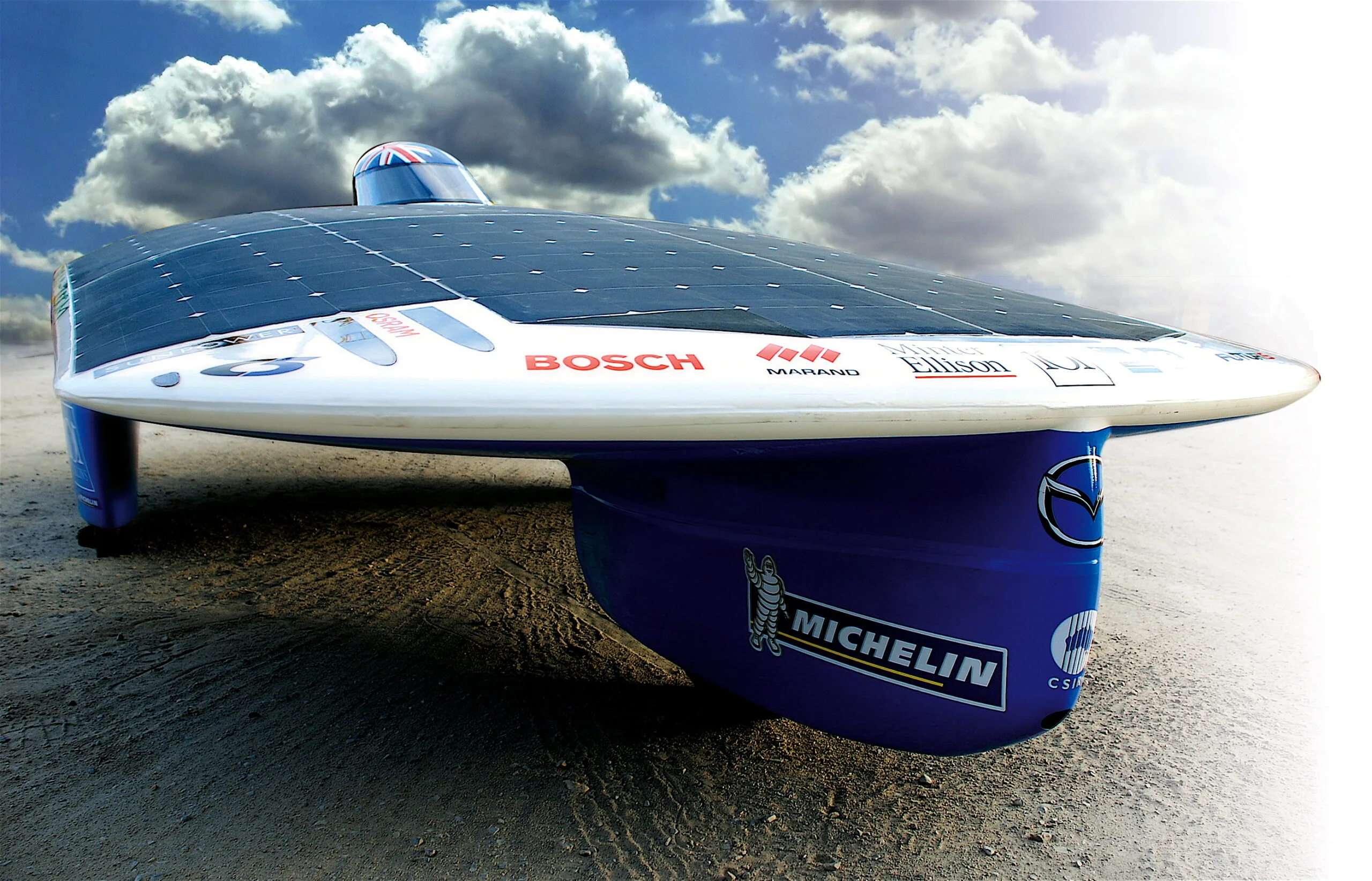
The World Solar Challenge runs through Australia, but for most of its history the winners came from Japan, the Netherlands, the USA and elsewhere. The exception is Aurora 101, built not by a university or a car company but by the Aurora Vehicle Association, a non-profit group of engineers in Melbourne.
Aurora 101 is built around a triangular carbon-fibre frame with a single driven front wheel and two rear wheels. Its solar array covers 5.98 m² with about 3,800 PERL silicon cells (“passivated emitter, rear locally diffused”). These were designed by Professor Martin Green at the University of New South Wales and reached 21–25% efficiency, world-class at the time. The array delivered up to about 1,250 W.
The 1.8 kW motor, weighing only 15 kg, was developed jointly by CSIRO, the University of Technology Sydney and Aurora. In full race trim, including batteries and driver, the car weighs about 240 kg.
In the 1999 World Solar Challenge Aurora 101 crossed the continent at an average of 72.96 km/h and won. It remains the only outright Australian win in the race’s history. A great example of what a dedicated group of volunteers can achieve.
Technical data
| Builder | Aurora Vehicle Association (non-profit, Melbourne) |
|---|---|
| Layout | Triangular carbon-fibre frame; 1 driven front wheel, 2 rear wheels |
| Solar | 5.98 m², ~3,800 UNSW PERL cells (21–25%), up to ~1,250 W |
| Motor | 1.8 kW continuous, 15 kg (CSIRO / UTS / Aurora) |
| Race weight | ~240 kg incl. batteries and driver |
| Result | World Solar Challenge 1999 winner, Ø 72.96 km/h |
Photo: Martin Brooks / Wikimedia Commons, FAL
Sources: Wikipedia: Aurora Solar Car · Wikipedia: 1999 World Solar Challenge · Laser Focus World