
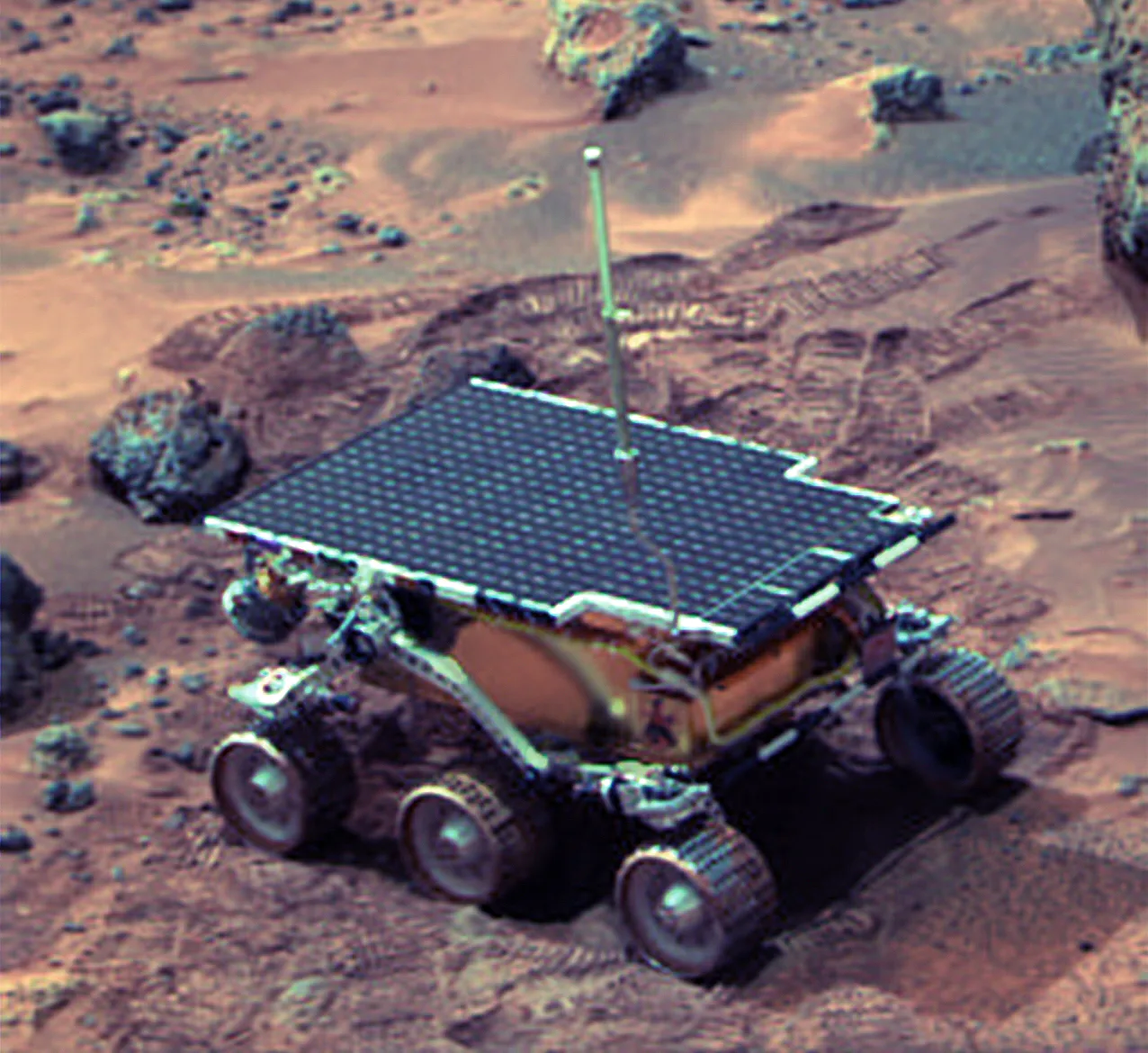
Today’s Mars rovers are the size of cars. The first one was the size of a microwave oven. Sojourner, built by NASA’s Jet Propulsion Laboratory, landed with the Mars Pathfinder mission on 4 July 1997 and became the first wheeled vehicle to drive on another planet.
The rover was just 65 cm long, 48 cm wide and 30 cm high and weighed about 11.5 kg. It rolled on six aluminium wheels with the now-famous rocker-bogie suspension, which later Mars rovers inherited. Its whole top was a solar panel: 0.22 m² of cells producing at most about 15 W on Mars, less than a household light bulb. A non-rechargeable lithium battery provided backup. Top speed was a stately 1 cm per second.
Sojourner was designed to work for only about a week. It kept going for about 83 sols (Martian days), drove a little over 100 m around the landing site, took about 550 images, and analysed rocks with nicknames like Barnacle Bill and Yogi. This picture shows it beside a rock nicknamed “The Dice”.
Without Sojourner there would have been no Spirit and Opportunity, and no solar-powered decade of exploring Mars.
Technical data
| Builder | NASA Jet Propulsion Laboratory (JPL) |
|---|---|
| Landing | 4 July 1997, Ares Vallis (Mars Pathfinder) |
| Wheels | 6 aluminium wheels, rocker-bogie suspension |
| Size / mass | 65 × 48 × 30 cm, ~11.5 kg |
| Solar | 0.22 m², max. ~15 W on Mars; backup lithium battery (non-rechargeable) |
| Speed | 1 cm/s |
| Mission | ~83 sols (design: ~1 week), ~100 m driven, ~550 images |
Photo (NASA/JPL): NASA / Wikimedia Commons, Public domain
Sources: Wikipedia: Sojourner