
A boat that flies sounds like science fiction. On a solar budget of a few square metres of panels, though, it is a necessity. Water creates enormous drag, so the TU Delft Solar Boat Team lifts its hull clear of the water on hydrofoils, underwater wings that work like an aircraft wing.
The team introduced hydrofoils in 2010 and has since developed them into electronically controlled foils that constantly adjust for stability, manoeuvrability and efficiency. The boats are designed, built and raced by students.
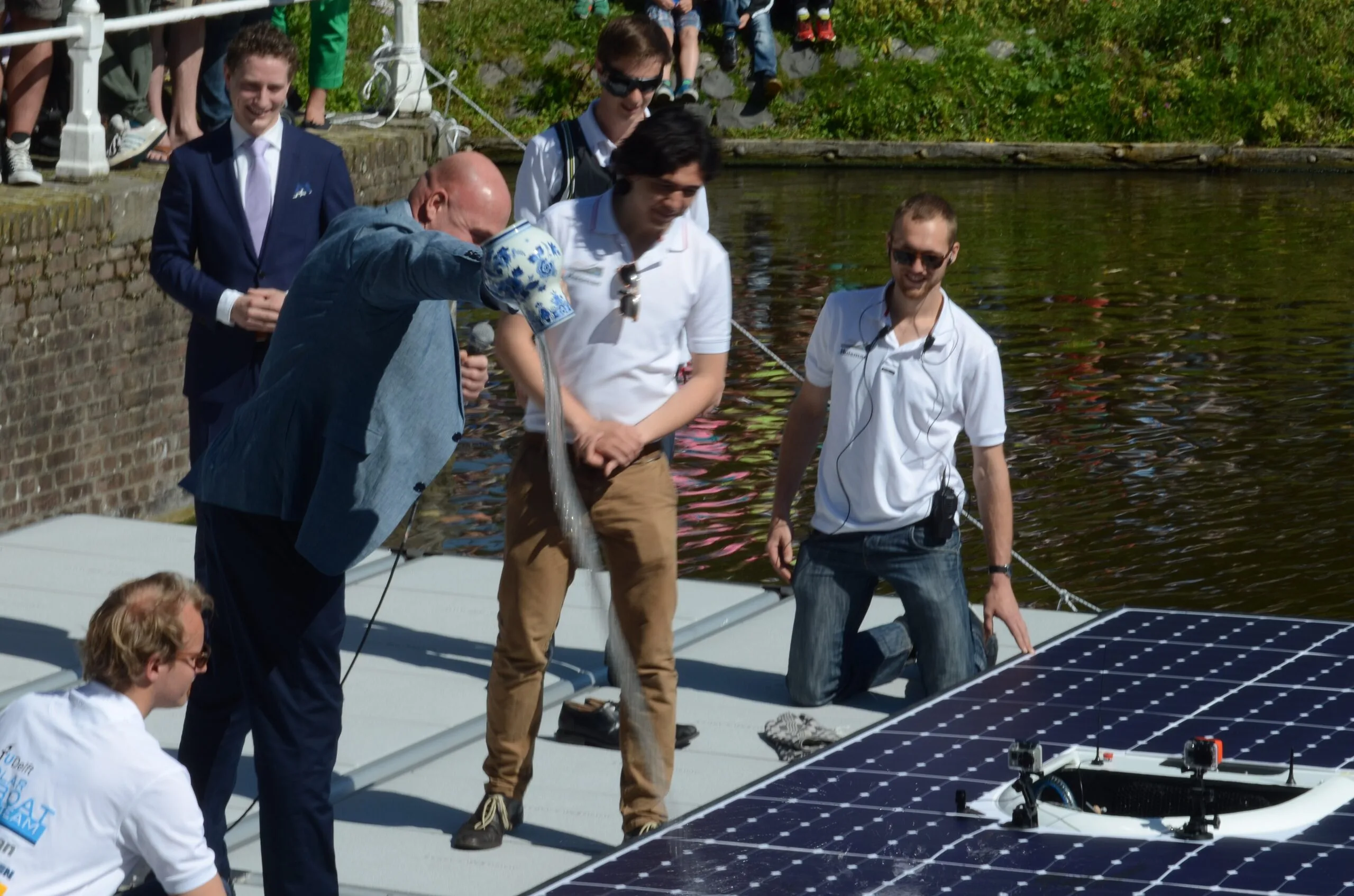
The 2014 boat was christened by Dutch astronaut André Kuipers (pictured). That year 40 teams tackled the 240 km Dutch Solar Challenge. Delft was running second until the last day, when a gust of wind capsized the boat just 1,000 m from the finish. They finished fourth, but the new hydrofoil concept won the Design Award.
The team came back stronger. In 2015 it entered the Monaco Solar Boat Challenge for the first time and won the open-sea race. Later teams prepared for even bigger challenges, such as crossing the English Channel.
Technical data
| Builder | TU Delft Solar Boat Team (students), Delft University of Technology |
|---|---|
| Concept | Solar-electric racing boat on electronically controlled hydrofoils |
| Hydrofoils | Since 2010 |
| 2014 | Christened by astronaut André Kuipers; Dutch Solar Challenge (240 km): 4th place + Design Award |
| 2015 | Monaco Solar Boat Challenge: winner of the open-sea race |
Photo (christening, 2014): Gbvm2 / Wikimedia Commons, CC BY-SA 4.0
Sources: A3 / automate.org · Plugboats