
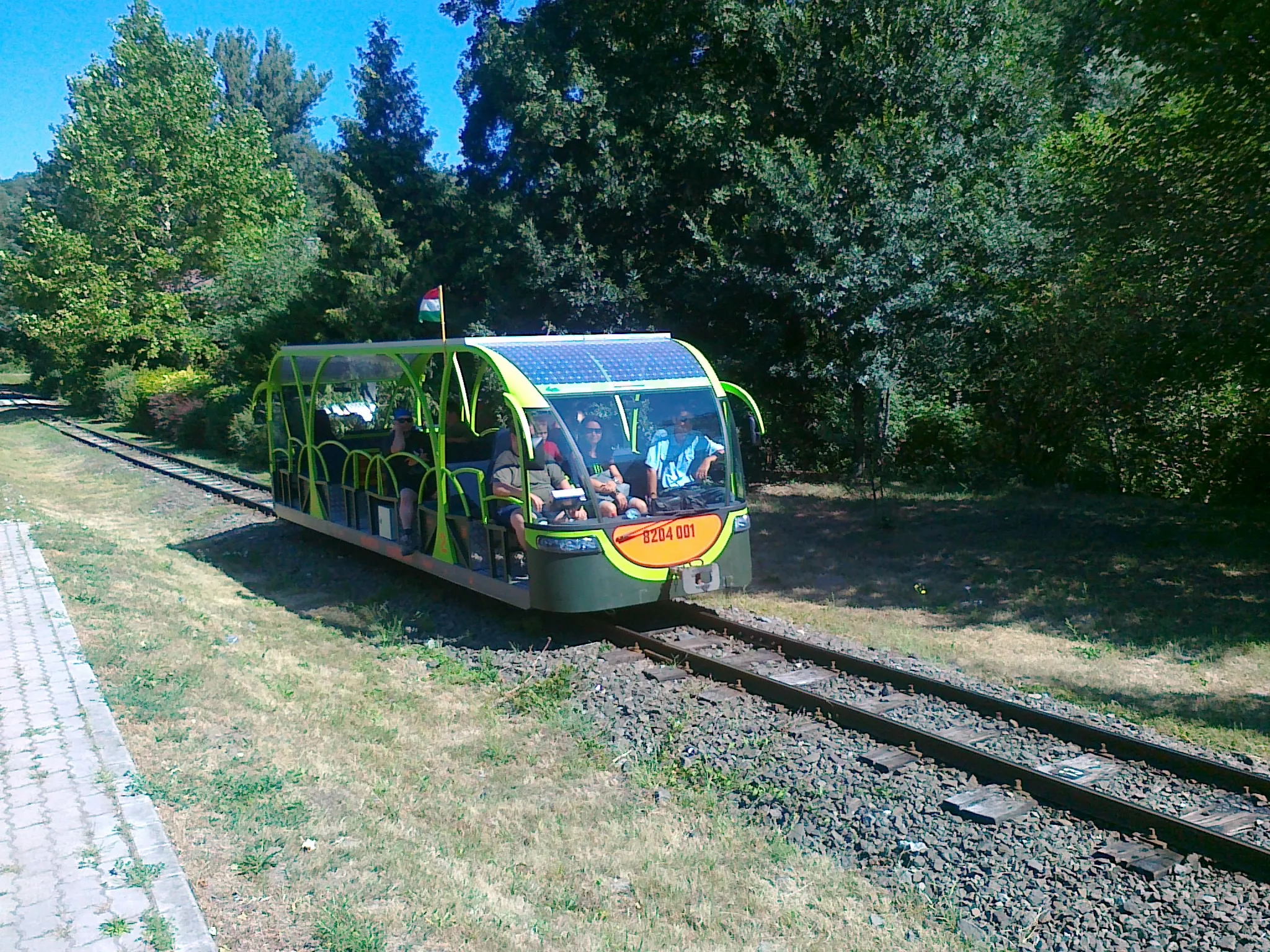
North of Budapest, a small narrow-gauge forest railway climbs from the Danube town of Kismaros into the wooded Börzsöny hills to Királyrét. In summer, some of its passengers travel in one of Europe’s most unusual rail vehicles: an open, solar-powered railcar.
It was unveiled at the line’s forest railway festival in May 2010. The frame and mechanical parts came from Börzsöny 2020, the electrical system from Hungarotrain, and the documentation from GanzPlan. The roof carries 9.9 m² of solar cells that charge an on-board battery. Two 7 kW asynchronous motors, one on each axle, drive the car, and regenerative braking recovers energy on the way down.
The 12 km line climbs all the way up, so a full battery stores enough energy for four or five uphill trips. The return downhill needs very little power. The battery can also be topped up from the mains.
The railcar is 8.3 m long, has 32 seats, a low 36 cm entry and a gentle top speed of 25 km/h, just right for watching the forest go by.
Technical data
| Builders | Börzsöny 2020 (mechanics), Hungarotrain (electrics), GanzPlan (documentation) |
|---|---|
| Line | Kismaros – Királyrét forest railway, 12 km, 760 mm gauge |
| Unveiled | May 2010 |
| Solar | 9.9 m² on the roof |
| Motors | 2 × 7 kW asynchronous (one per axle), regenerative braking |
| Battery | On board, enough for 4–5 uphill trips; mains top-up possible |
| Size | 8,275 × 2,000 mm, entry height 360 mm |
| Seats | 32 |
| Top speed | 25 km/h |
Photo: Rlevente / Wikimedia Commons, CC BY-SA 3.0
Sources: Railway Gazette · Green Car Reports