
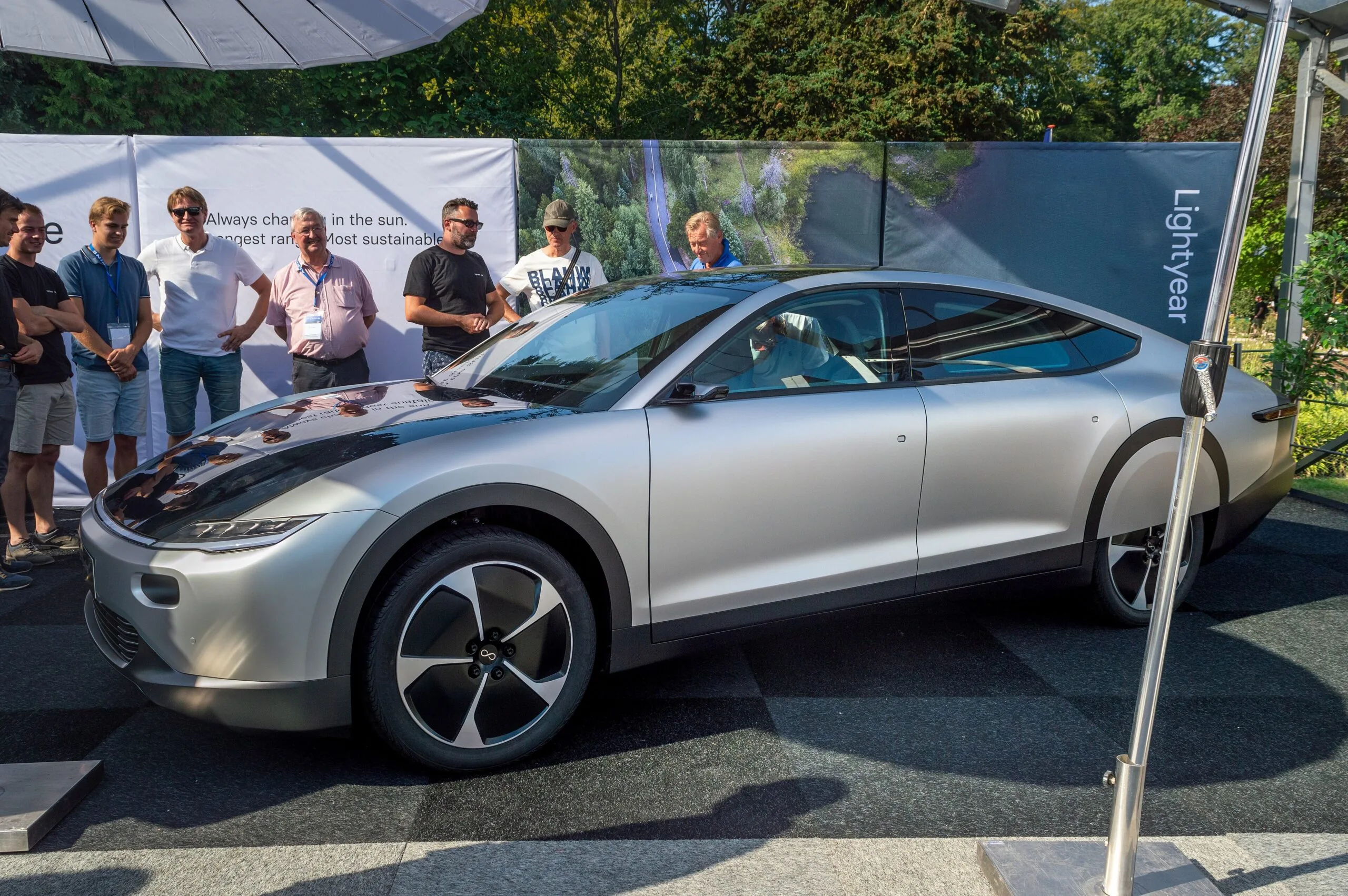
What if your car simply charged itself while it stood in the parking lot? That was the promise of the Lightyear 0, built by the Dutch start-up Lightyear — a company founded by former members of Solar Team Eindhoven, the student team behind the award-winning Stella family solar cars.
The project was first shown as the Lightyear One prototype on 25 June 2019 (the car pictured here). In June 2022 the production version was revealed as the Lightyear 0, and in December 2022 the company announced that production had begun at a rate of about one car per week.
The bonnet, roof and boot are covered with 5 m² of curved solar cells — 782 cells in total. In good summer conditions they can add up to 70 km of driving range per day. For a typical commuter that means weeks — in sunny regions even months — without plugging in.
Under the skin, efficiency was everything: four in-wheel motors with a combined 130 kW (174 hp), an extremely aerodynamic 5-metre body, and a relatively small 60 kWh battery that still delivered a WLTP range of 625 km.
The catch was the price: around €250,000 excluding VAT. In January 2023 Lightyear halted production of the 0 to focus on a cheaper mass-market model, so only a handful of cars were ever built. Still, the Lightyear 0 showed that a road-legal, everyday solar car is technically possible — and many of its ideas live on in today’s solar EV projects.
Technical data
| Builder | Lightyear, Helmond (Netherlands) |
|---|---|
| Solar | 782 cells, 5 m² on bonnet, roof and boot, up to 70 km of range per day |
| Battery | 60 kWh |
| Range | 625 km (WLTP) |
| Drive | 4 in-wheel motors, 130 kW combined |
| Length / weight | 5,057 mm / ~1,575 kg |
| Price | ~€250,000 excl. VAT |
| Production | Deliveries from December 2022, halted January 2023 |
Photo (Lightyear One prototype, 2019): Tristan Surtel / Wikimedia Commons, CC BY-SA 4.0
Sources: Wikipedia: Lightyear 0 · electrive · TechRadar