
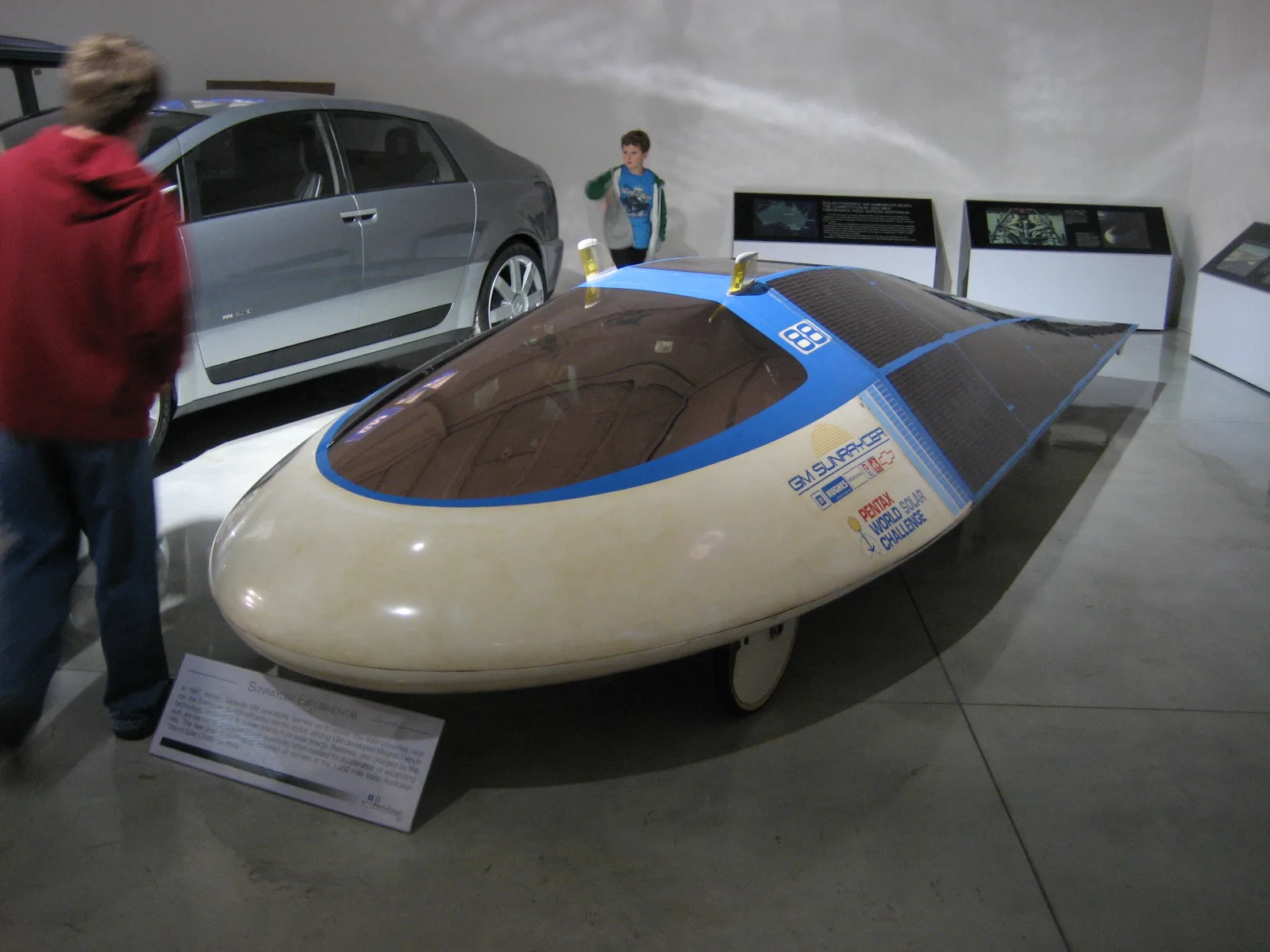
Every solar race car you see today owes something to Sunraycer. In 1987 the very first World Solar Challenge sent a field of experimental solar vehicles about 3,000 km from Darwin to Adelaide. General Motors arrived with a car that looked like nothing else on the road, and it won by a huge margin.
Sunraycer was a joint project of General Motors, AeroVironment (Paul MacCready’s company, the team behind the Gossamer Penguin) and Hughes Aircraft, which supplied space-grade solar cells. The teardrop-shaped body, about 6 m long, 2 m wide and only 1 m high, was made of Kevlar and covered with several thousand solar cells (sources give figures between about 7,200 and 8,800). It weighed only about 265 kg (585 lb), and its electric motor was rated around 1.5 kW.
One clever detail: when the driver lifted off the accelerator, the drive motor in the left-rear wheel worked as a generator, feeding energy back into the battery. This is regenerative braking, standard on every EV today and rare in 1987.
Sunraycer completed the race in about 45 hours of driving at an average of 66.9 km/h and finished roughly two days ahead of the next competitor. Much of what GM learned fed directly into its later electric car work. The car is now preserved at the GM Heritage Center, where this photo was taken.
Technical data
| Builders | General Motors, AeroVironment, Hughes Aircraft (USA) |
|---|---|
| Type | Single-seat, four-wheeled solar race car |
| Size | ~6 × 2 × 1 m, Kevlar body |
| Weight | ~265 kg (585 lb) |
| Solar | Several thousand Hughes cells (≈ 7,200–8,800 depending on source) |
| Motor | ~1.5 kW; drive motor doubles as generator (regenerative braking) |
| Result | Winner, World Solar Challenge 1987, Ø 66.9 km/h, ~45 h driving time |
| Today | GM Heritage Center |
Photo (GM Heritage Center): Dshakes / Wikimedia Commons, CC BY-SA 3.0
Sources: Wikipedia: Sunraycer · Wikipedia: World Solar Challenge 1987 · carstyling.ru