
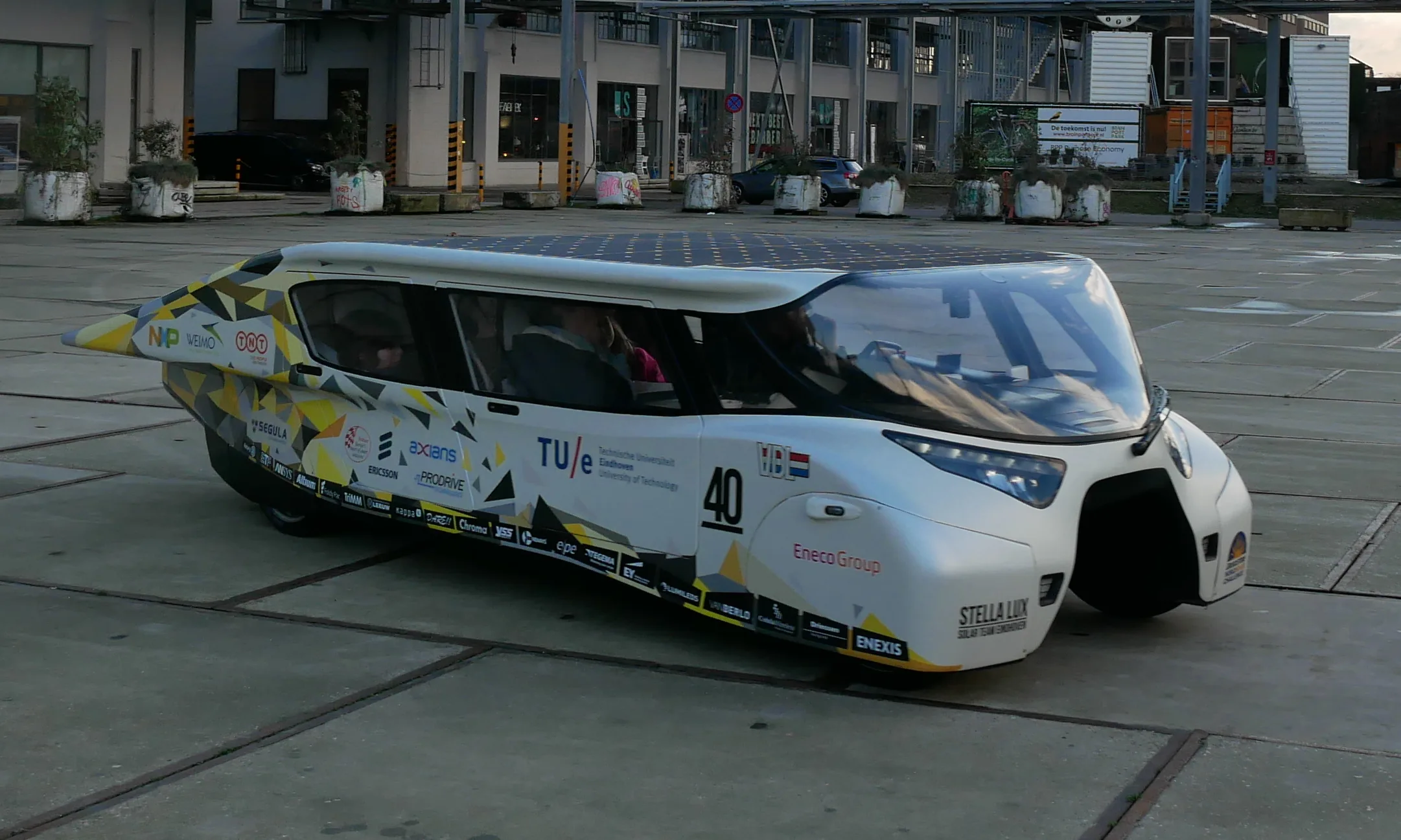
Two years after their first family solar car, the students of Solar Team Eindhoven set themselves an even bolder target: a car that, over a year, produces more energy than it uses. The result was Stella Lux.
Stella Lux seats four people, is 4.52 m long and weighs only 375 kg, thanks to carbon fibre and aluminium. Its roof carries 381 solar cells on 5.8 m², and the battery holds 15 kWh. On a sunny day in Australia it could drive about 1,100 km, and in the Netherlands the team calculated a range of at least 1,000 km.
The “energy-positive” claim comes from everyday maths. The panels generate enough for around 40 km per day in a Dutch winter and up to 310 km in summer. An average Dutch driver covers about 37 km a day, so over the year the car makes more than it uses, and the surplus can go back into the grid.
In October 2015 Stella Lux won the Cruiser Class of the Bridgestone World Solar Challenge. It was the team’s second world title, before Stella Vie (2017) and the founding of Lightyear.
Technical data
| Builder | Solar Team Eindhoven, TU Eindhoven (NL) |
|---|---|
| Seats | 4 |
| Size | 4.52 × 1.76 × 1.12 m |
| Weight | 375 kg |
| Solar | 381 cells, 5.8 m² |
| Battery | 15 kWh |
| Range | ~1,100 km on a sunny day in Australia; ≥ 1,000 km (NL estimate) |
| Top speed | 125 km/h |
| Result | World Solar Challenge 2015, Cruiser Class winner |
Photo: SolarEHV / Wikimedia Commons, CC BY-SA 4.0
Sources: Electrek · Eindhoven News · Wikipedia: Solar Team Eindhoven